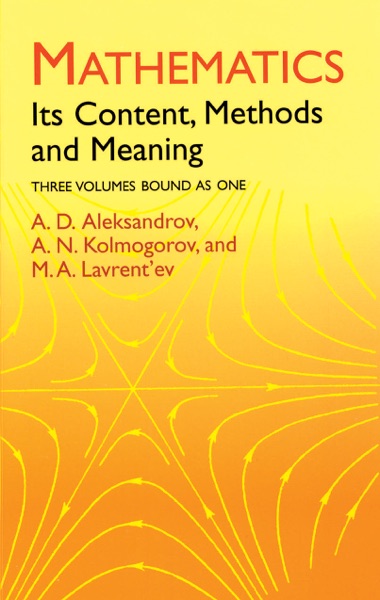
Mathematics: Its Content, Methods and Meaning by Aleksandrov, Kolmogorov & Lavrent'ev is a 1963 science book about mathematics, logic, history of science. Mathematics is a unified intellectual enterprise, not a collection of disconnected techniques; understanding the connections between branches is as important as mastering any single one.
Summary
Mathematics: Its Content, Methods and Meaning is a three-volume survey of mathematics compiled by a group of eminent Soviet mathematicians, originally published in Russian in 1956 and translated into English by the American Mathematical Society in 1963. The work was edited by Aleksei Aleksandrov, Andrei Kolmogorov, and Mikhail Lavrent'ev — three of the leading Soviet mathematicians of the twentieth century — and was written for educated readers without advanced mathematical training, though it demands genuine intellectual effort throughout.
The ambition of the project is remarkable: to survey the entire landscape of mathematics as it existed in the mid-twentieth century, explaining not just the content of each field but its methods, its history, and its relationship to other branches of mathematics and to the sciences. The volumes cover analysis, algebra, geometry, topology, differential equations, probability theory, mathematical physics, number theory, and more. Each chapter was written by a specialist, which gives the treatment unusual depth, though it also means the writing quality and accessibility vary considerably.
What distinguishes this work from a textbook is its sustained attention to why mathematics looks the way it does — why certain problems were asked, what historical pressures shaped particular branches, how mathematical intuition develops alongside formal proof. The editors were committed to the view that mathematics is a coherent intellectual enterprise, not a collection of disconnected techniques, and that understanding the whole is important for understanding any part. The sections on the philosophy and nature of mathematics — particularly Kolmogorov's contributions — reflect the Soviet tradition of engaging seriously with questions that Western mathematics often treated as outside the discipline.
The work is necessarily demanding. It was not written for casual readers, and several sections require prior exposure to calculus or algebra to follow the arguments. But for mathematically curious readers who want to understand where modern mathematics comes from and how its major branches relate to each other, it remains one of the most comprehensive and honest surveys ever written. Richard Feynman reportedly kept a copy and recommended it. The book asks more of the reader than almost anything else on a popular mathematics shelf, and returns more.
Talk to Mathematics: Its Content, Methods and Meaning like its author wrote you back.
Get the ideas that fit your life — not generic summaries.
- Chat with the book
- Audiobook-style main ideas
- Adapts to your life and goals
- Helps you take action
Key takeaways
- 1.
Mathematics is a unified intellectual enterprise, not a collection of disconnected techniques; understanding the connections between branches is as important as mastering any single one.
- 2.
Mathematical intuition and formal proof are complementary, not opposed: the intuition suggests what to prove, and the proof reveals whether the intuition was correct and what its scope actually is.
- 3.
The history of mathematics is inseparable from its content: why a problem was posed, what tools were available, and what analogies were productive are part of understanding why a result is true.
- 4.
Probability theory, topology, and abstract algebra emerged as unified disciplines in the twentieth century from problems that had seemed unrelated, revealing deep structural connections.
- 5.
Applied mathematics and pure mathematics are not cleanly separable: the most abstract results often find unexpected physical applications, and physical problems regularly produce new mathematical structures.
- 6.
The rigor of modern mathematics — axiomatic foundations, formal proof — developed partly as a response to paradoxes that revealed the inadequacy of intuitive reasoning about infinite sets.
- 7.
Differential equations are among the most powerful tools in the mathematical sciences precisely because natural laws are expressed in terms of rates of change, not absolute values.
- 8.
Number theory, despite dealing with the simplest objects in mathematics, has produced some of its deepest and most resistant problems, suggesting that simplicity of object does not imply simplicity of structure.
Discussion questions
Use these on your own, with a book club, or as chat starters in Superbook. Book club version, ready to copy or print →
- 1.
The editors argue that mathematics should be understood as a whole, not as isolated techniques. Do you find that aspiration realistic for a working scientist or engineer, or is specialization inevitable?
- 2.
Kolmogorov's sections on probability theory helped establish it as a rigorous branch of mathematics rather than applied common sense. Why did that formalization matter, and what did it cost?
- 3.
The work was originally written in the Soviet Union in the 1950s. Does the intellectual tradition of the authors — committed to both rigor and philosophical engagement — differ from the Western mathematical tradition you're familiar with?
- 4.
Richard Feynman reportedly admired this work. What do you think a physicist would find here that standard physics education doesn't provide?
- 5.
The book is three volumes and 1,400 pages. Is that scope a strength or an obstacle? What would a shorter version lose?
- 6.
The writing quality varies by contributor. Which sections did you find most accessible, and which most demanding? Does that variation itself tell you something about the fields they cover?
- 7.
The relationship between pure and applied mathematics is a recurring theme. Can you think of a recent example where abstract mathematics found an unexpected application?
- 8.
The book treats the philosophy of mathematics — what mathematics is, whether mathematical objects exist — as a serious subject. Is that a question you find interesting, or does it feel like a distraction from actual mathematics?
- 9.
Mathematics was written during the Cold War by Soviet mathematicians for a Soviet audience. Are there ways in which the ideological context shaped the presentation?
- 10.
The sections on foundations — set theory, mathematical logic — address paradoxes that undermined naive intuitions about infinity. Has encountering those paradoxes changed how you think about mathematical certainty?
- 11.
How does reading a comprehensive survey like this compare to learning mathematics through a more specialized text or a course? What does breadth provide that depth doesn't?
- 12.
If you were to recommend one chapter of this work to a non-mathematician, which would it be and why?
Themes
Frequently asked questions
-
Is Mathematics: Its Content, Methods and Meaning accessible to non-mathematicians?
Partially. The introductory sections of each chapter are generally accessible to anyone with high school mathematics. Many of the more advanced sections require prior exposure to calculus or linear algebra. It is best approached as a text to read selectively rather than cover to cover.
-
How long does it take to read?
The complete work is around 1,400 pages across three volumes. A full read at a thoughtful pace takes 25 to 30 hours. Most readers work through it selectively over months or years, following their own mathematical interests.
-
Is this still the best comprehensive survey of mathematics?
It is one of the most respected. It reflects the state of mathematics in the 1950s, so recent developments (complexity theory, modern algebraic geometry, formal verification) are absent. For the material it covers, however, the depth and clarity remain largely unmatched in a single accessible work.
-
Why did Richard Feynman recommend this book?
Feynman valued books that explained the why alongside the how — the motivations, historical context, and connections between ideas rather than just the techniques. This work does that more consistently than most mathematics texts, which made it attractive to a physicist interested in mathematical structure rather than just computation.
-
Who should read this book?
Mathematically curious readers who want to understand the breadth and unity of mathematics, graduate students in mathematics or physics who want historical and philosophical context for what they are learning, and anyone who has wondered what lies beyond the calculus and statistics they encountered in school.
Similar books
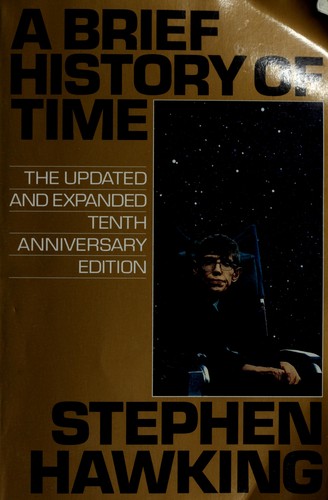
A Brief History of Time
Stephen Hawking
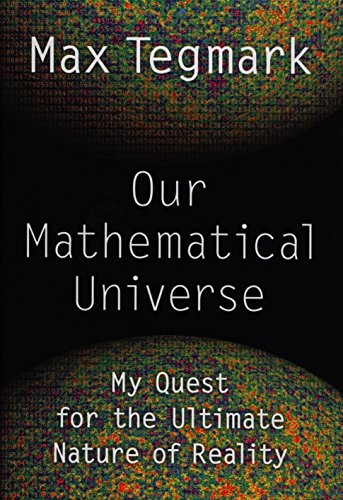
Our Mathematical Universe
Max Tegmark
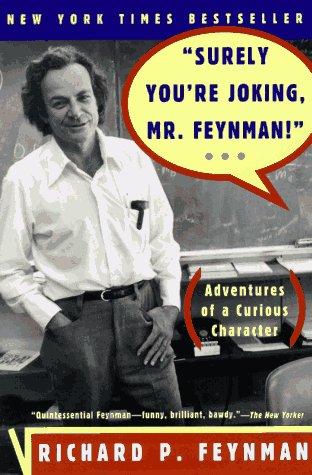
Surely You're Joking, Mr. Feynman!
Richard P. Feynman
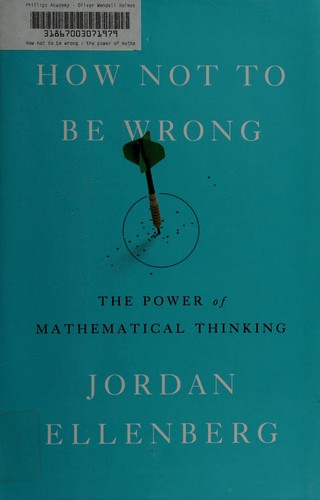
How Not to Be Wrong: The Power of Mathematical Thinking
Jordan Ellenberg
