Psychology · Book club
Mating in Captivity: Unlocking Erotic Intelligence book club questions
Here are 12 book club questions for Mating in Captivity: Unlocking Erotic Intelligence by Esther Perel, ordered to open easily and end somewhere worth arguing about. Copy them, print them, or bring them up one at a time.
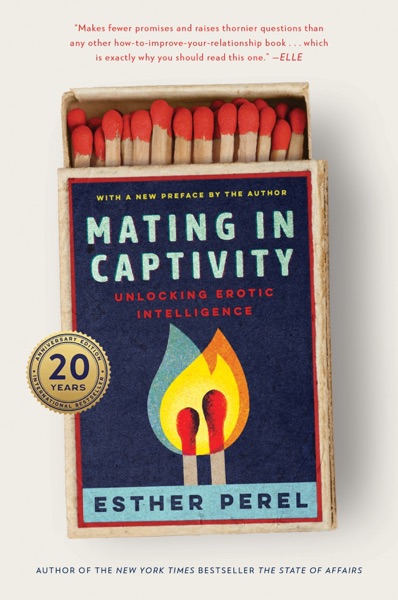
Mating in Captivity is Esther Perel's examination of a paradox at the center of modern long-term relationships: the very things that create closeness and security — familiarity, predictability, mutual care — tend to undermine erotic desire.
Esther Perel · 2006 · 5h 15m
Full summary and key takeaways →The 12 questions
- 1.
Perel's central claim is that love and desire often work against each other in long-term relationships. Is that consistent with your own experience or observation?
- 2.
She argues that modern relationships ask their partners to fulfill more roles simultaneously than historical relationships did. Is that a problem to be managed, or a genuine advance in what intimate partnership can offer?
- 3.
The book says that desire often requires that the partner be seen as separate and autonomous, not fully merged. What does that look like in practice in a relationship where you also share a home, finances, and children?
- 4.
Perel is unusually candid about the role of transgression and the forbidden in maintaining desire. Did that part of the argument feel honest, theoretical, or uncomfortable?
- 5.
How does parenthood change the erotic dynamic in relationships? Does Perel's account of it match anything you've observed in your own life or in people close to you?
- 6.
The book draws on clinical material from couples across many cultures. Did you notice a particular cultural assumption built into the argument that felt specific to a Western or American context?
- 7.
Perel distinguishes between intimacy and eroticism and argues that conflating them damages both. Can you articulate that distinction in your own terms?
- 8.
She is deliberately non-prescriptive about relationship structures. Does that make the book more honest or less useful for someone looking for practical guidance?
- 9.
What is the most difficult idea in the book for you personally? What makes it difficult?
- 10.
The book was published in 2006. How has the cultural context for the conversation it opens — about desire, intimacy, monogamy — changed since then?
- 11.
Perel says some relationships have genuinely reached the limit of what they can offer, and she is honest about that. Is that kind of honesty useful in a book like this, or does it undermine the argument for working on the tension?
- 12.
If the goal of the book is to help people understand the tension rather than resolve it, what would you do differently in a relationship based on having read it?
How to run the discussion
- Pick six to eight, not all of them. An hour of real discussion covers fewer questions than anyone expects, and racing the list is what makes a book club feel like homework.
- Open with what people noticed, not what they concluded. Asking for a verdict first hardens opinions before anyone has heard each other.
- Let the disagreement run. The questions below that split a room are the ones worth the time; the ones everyone answers the same way can be skipped.
- Ask the quiet person a specific question. A direct, narrow question is far easier to answer than an open invitation to contribute.
Themes worth steering toward
If the conversation stalls, these are the threads that usually restart it.
Common questions
What are good book club questions for Mating in Captivity: Unlocking Erotic Intelligence?
Here are 12 book club questions for Mating in Captivity: Unlocking Erotic Intelligence by Esther Perel, ordered to open easily and end somewhere worth arguing about. The strongest openers ask what each reader noticed rather than what they concluded, and the discussion usually turns on desire and intimacy, long-term relationships, sexuality.
How long should a book club discussion of Mating in Captivity: Unlocking Erotic Intelligence last?
Most groups run 60 to 90 minutes of actual discussion. That is roughly six to eight questions, not all of them, so pick the ones that suit your group rather than working down the list in order.
What are the main themes in Mating in Captivity: Unlocking Erotic Intelligence?
Desire and intimacy, Long-term relationships, Sexuality, Identity and partnership, Erotic intelligence. Those are the threads most likely to divide a room, which makes them the useful places to steer a discussion that has gone quiet.
Picking the next one? See books like Mating in Captivity: Unlocking Erotic Intelligence or questions for other book club picks.
