Talk to Maverick like its author wrote you back.
Get the ideas that fit your life — not generic summaries.
- Chat with the book
- Audiobook-style main ideas
- Adapts to your life and goals
- Helps you take action
What it argues
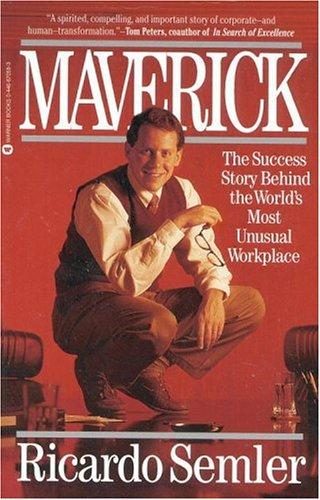
Ricardo Semler inherited a Brazilian industrial manufacturer, Semco, from his father in the early 1980s and proceeded to dismantle almost every conventional management structure in it. Maverick is his account of how and why, written in 1993 after the company had survived several Brazilian economic crises and a period of explosive growth. The result is one of the most unusual business memoirs on record: a firsthand description of a company where workers set their own salaries, choose their own managers, set their own hours, and have access to all financial information.
The core of Semler's argument is that traditional hierarchical management rests on an unfounded assumption: that workers cannot be trusted without supervision. Semco tested the opposite assumption — that adults with real information and genuine authority will make better decisions about their work than supervisors imposed from above — and found it largely true. Workers who set their own salaries set them roughly at market rates. Factory floor employees who were involved in redesigning the production process found improvements that engineers had missed. Managers who were evaluated by their teams became better managers.
What it gets right
- 1.
Workers who set their own salaries with access to market data and company financials typically set them at market rates, not inflated ones.
- 2.
Most management overhead exists to compensate for lack of trust. Remove the overhead and replace it with information, and behavior often improves.
- 3.
Hierarchical layers slow decision-making and insulate decisions from the people most affected by them. Flattening hierarchy speeds adaptation.
What it covers
Who wrote it
Ricardo Semler is a Brazilian entrepreneur who took over Semco Partners from his father in the early 1980s and transformed it from a conventional industrial manufacturer into a globally recognized experiment in participatory management. Under his leadership, Semco grew revenue substantially while eliminating most traditional management controls. He later wrote The Seven Day Weekend (2003), continuing his exploration of work and autonomy. Semler has lectured widely at business schools and has become one of the most cited voices in the debate over workplace democracy and organizational design.
