Talk to Maverick like its author wrote you back.
Get the ideas that fit your life — not generic summaries.
- Chat with the book
- Audiobook-style main ideas
- Adapts to your life and goals
- Helps you take action
Maverick, in detail
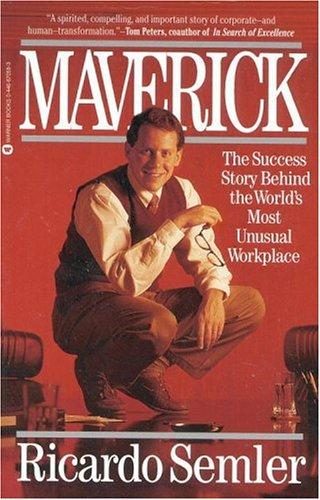
Ricardo Semler inherited a Brazilian industrial manufacturer, Semco, from his father in the early 1980s and proceeded to dismantle almost every conventional management structure in it. Maverick is his account of how and why, written in 1993 after the company had survived several Brazilian economic crises and a period of explosive growth. The result is one of the most unusual business memoirs on record: a firsthand description of a company where workers set their own salaries, choose their own managers, set their own hours, and have access to all financial information.
The core of Semler's argument is that traditional hierarchical management rests on an unfounded assumption: that workers cannot be trusted without supervision. Semco tested the opposite assumption — that adults with real information and genuine authority will make better decisions about their work than supervisors imposed from above — and found it largely true. Workers who set their own salaries set them roughly at market rates. Factory floor employees who were involved in redesigning the production process found improvements that engineers had missed. Managers who were evaluated by their teams became better managers.
The book is not a management framework but a memoir of improvisation. Semler does not present a system to install; he describes a series of experiments, some of which failed, most of which succeeded, and all of which emerged from genuine conviction rather than strategic calculation. He abolished executive dining rooms, eliminated dress codes, required no one to work set hours, and gave factory workers input into major capital decisions. The Brazilian context — hyperinflation, labor unrest, political instability — makes some of the story feel remote, but the organizational experiments are portable.
Semler is an engaging writer with a sharp sense of comedy about the absurdity of corporate ritual. The book has weaknesses: it can feel anecdotal where a more systematic reader might want data, and there is an occasional tendency toward self-congratulation. But the core claim is made persuasively. Semco under Semler's management grew revenue substantially, maintained high employee retention, and weathered crises that destroyed comparable companies. The experiment worked, at least at Semco's scale, and the question it poses — why don't more organizations try this? — remains unanswered.
The big ideas
- 1.
Workers who set their own salaries with access to market data and company financials typically set them at market rates, not inflated ones.
- 2.
Most management overhead exists to compensate for lack of trust. Remove the overhead and replace it with information, and behavior often improves.
- 3.
Hierarchical layers slow decision-making and insulate decisions from the people most affected by them. Flattening hierarchy speeds adaptation.
