Talk to Measure What Matters like its author wrote you back.
Get the ideas that fit your life — not generic summaries.
- Chat with the book
- Audiobook-style main ideas
- Adapts to your life and goals
- Helps you take action
What it argues
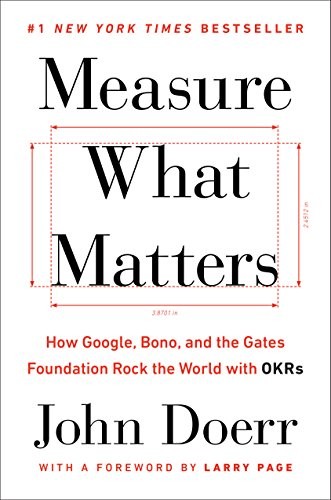
Measure What Matters is John Doerr's account of Objectives and Key Results — the goal-setting framework he learned from Andy Grove at Intel, carried to Google in 1999, and has since deployed across hundreds of companies and nonprofits. An OKR pairs an ambitious qualitative objective ("make the best product on the market") with three to five concrete, measurable key results that define what achieving that objective actually looks like. The framework is simple on paper. The hard part is deciding what to measure, and accepting that most things you're doing probably won't make the list.
The book alternates between Doerr's explanation of OKRs and case studies from companies he has backed or advised — Google, Intel, YouTube, Bono's ONE campaign, the Gates Foundation. The structure can feel uneven: some chapters are 80% testimonial, which slows the practical throughline. But the case studies serve a real purpose. They show that OKRs work very differently at a two-person startup versus a 20,000-person company, and that the failure modes (setting too many OKRs, treating them as performance reviews, never stretching beyond comfort) are common enough to be worth cataloging.
What it gets right
- 1.
OKRs pair a clear qualitative objective with three to five measurable key results. The objective sets direction; the key results define what hitting it actually means.
- 2.
Committed OKRs are targets a team must meet. Aspirational OKRs (moonshots) are stretch goals where 70% completion counts as success — if you hit 100%, the goal wasn't ambitious enough.
- 3.
Focus is the first superpower of OKRs. Grove's rule: no more than five objectives per cycle, each with no more than five key results. Everything else is noise.
What it covers
Who wrote it
John Doerr is a venture capitalist and chairman of Kleiner Perkins, one of Silicon Valley's most prominent investment firms. He has backed companies including Google, Amazon, Intuit, and Genentech. Doerr learned OKRs from Andy Grove during his time at Intel and introduced the framework to Google's founders in 1999. He is also the author of Speed and Scale, a climate action plan published in 2021, and has been a major donor to Stanford University and various climate-focused organizations. He sits on the boards of several institutions including Google and the Obama Foundation.
