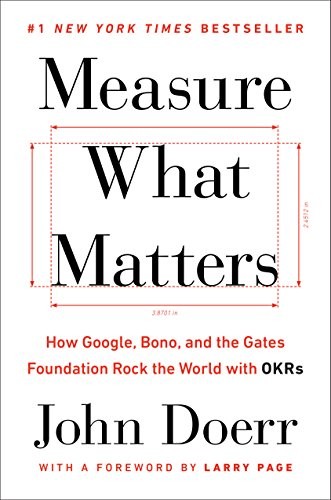
Talk to Measure What Matters like its author wrote you back.
Get the ideas that fit your life — not generic summaries.
- Chat with the book
- Audiobook-style main ideas
- Adapts to your life and goals
- Helps you take action
Measure What Matters, in detail
Measure What Matters is John Doerr's account of Objectives and Key Results — the goal-setting framework he learned from Andy Grove at Intel, carried to Google in 1999, and has since deployed across hundreds of companies and nonprofits. An OKR pairs an ambitious qualitative objective ("make the best product on the market") with three to five concrete, measurable key results that define what achieving that objective actually looks like. The framework is simple on paper. The hard part is deciding what to measure, and accepting that most things you're doing probably won't make the list.
The book alternates between Doerr's explanation of OKRs and case studies from companies he has backed or advised — Google, Intel, YouTube, Bono's ONE campaign, the Gates Foundation. The structure can feel uneven: some chapters are 80% testimonial, which slows the practical throughline. But the case studies serve a real purpose. They show that OKRs work very differently at a two-person startup versus a 20,000-person company, and that the failure modes (setting too many OKRs, treating them as performance reviews, never stretching beyond comfort) are common enough to be worth cataloging.
Doerr distinguishes between committed OKRs — targets the team must hit — and aspirational OKRs, sometimes called moonshots, where 70% completion is considered a success. The moonshot idea is one of the book's sharper contributions: it reframes failure. If every goal gets hit, the goals were too small. The chapter on "continuous performance management" — replacing annual reviews with more frequent check-ins tied to OKRs — is separately useful for managers, though it can read like an advertisement for Doerr's related investment in the Betterworks software platform.
The book is most valuable for leaders who sense their teams are working hard on the wrong things, or who want shared goals but keep watching priorities fracture between departments. OKRs won't fix a broken strategy, and Doerr is honest enough to say so. But as an alignment tool — making sure everyone in the building agrees on what matters this quarter — the framework is hard to beat for its simplicity.
The big ideas
- 1.
OKRs pair a clear qualitative objective with three to five measurable key results. The objective sets direction; the key results define what hitting it actually means.
- 2.
Committed OKRs are targets a team must meet. Aspirational OKRs (moonshots) are stretch goals where 70% completion counts as success — if you hit 100%, the goal wasn't ambitious enough.
- 3.
Focus is the first superpower of OKRs. Grove's rule: no more than five objectives per cycle, each with no more than five key results. Everything else is noise.
