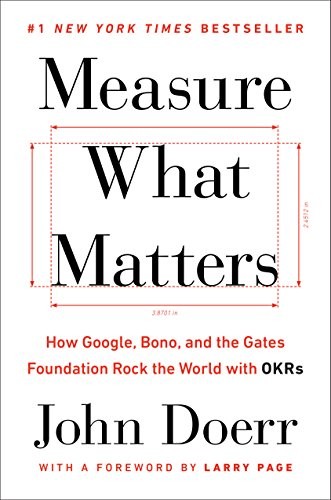
Measure What Matters by John Doerr is a 2017 business book about goal-setting, organizational performance, leadership. OKRs pair a clear qualitative objective with three to five measurable key results. The objective sets direction; the key results define what hitting it actually means.
Summary
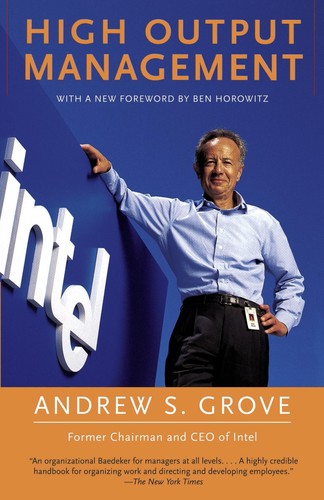
Measure What Matters is John Doerr's account of Objectives and Key Results — the goal-setting framework he learned from Andy Grove at Intel, carried to Google in 1999, and has since deployed across hundreds of companies and nonprofits. An OKR pairs an ambitious qualitative objective ("make the best product on the market") with three to five concrete, measurable key results that define what achieving that objective actually looks like. The framework is simple on paper. The hard part is deciding what to measure, and accepting that most things you're doing probably won't make the list.
The book alternates between Doerr's explanation of OKRs and case studies from companies he has backed or advised — Google, Intel, YouTube, Bono's ONE campaign, the Gates Foundation. The structure can feel uneven: some chapters are 80% testimonial, which slows the practical throughline. But the case studies serve a real purpose. They show that OKRs work very differently at a two-person startup versus a 20,000-person company, and that the failure modes (setting too many OKRs, treating them as performance reviews, never stretching beyond comfort) are common enough to be worth cataloging.
Doerr distinguishes between committed OKRs — targets the team must hit — and aspirational OKRs, sometimes called moonshots, where 70% completion is considered a success. The moonshot idea is one of the book's sharper contributions: it reframes failure. If every goal gets hit, the goals were too small. The chapter on "continuous performance management" — replacing annual reviews with more frequent check-ins tied to OKRs — is separately useful for managers, though it can read like an advertisement for Doerr's related investment in the Betterworks software platform.
The book is most valuable for leaders who sense their teams are working hard on the wrong things, or who want shared goals but keep watching priorities fracture between departments. OKRs won't fix a broken strategy, and Doerr is honest enough to say so. But as an alignment tool — making sure everyone in the building agrees on what matters this quarter — the framework is hard to beat for its simplicity.
Talk to Measure What Matters like its author wrote you back.
Get the ideas that fit your life — not generic summaries.
- Chat with the book
- Audiobook-style main ideas
- Adapts to your life and goals
- Helps you take action
Key takeaways
- 1.
OKRs pair a clear qualitative objective with three to five measurable key results. The objective sets direction; the key results define what hitting it actually means.
- 2.
Committed OKRs are targets a team must meet. Aspirational OKRs (moonshots) are stretch goals where 70% completion counts as success — if you hit 100%, the goal wasn't ambitious enough.
- 3.
Focus is the first superpower of OKRs. Grove's rule: no more than five objectives per cycle, each with no more than five key results. Everything else is noise.
- 4.
OKRs should be transparent. When every person in an organization can see every other team's goals, alignment becomes self-correcting rather than top-down.
- 5.
Bidirectional goal-setting outperforms pure top-down cascades. The most effective OKRs blend leadership priorities with goals the team itself proposes.
- 6.
OKRs and performance reviews should stay separate. Tying compensation directly to OKR scores distorts goal-setting — teams stop setting ambitious targets when their pay depends on hitting them.
- 7.
Tracking matters as much as setting. OKRs that are written and then ignored are worse than no OKRs — they signal that leadership doesn't actually mean what it says.
- 8.
The question OKRs answer is not 'what are we doing?' but 'why does it matter?' A good objective explains the purpose, not just the activity.
Discussion questions
Use these on your own, with a book club, or as chat starters in Superbook. Book club version, ready to copy or print →
- 1.
Doerr says the hardest part of OKRs is deciding what not to measure. What are three things your team or organization tracks that probably don't matter as much as you think?
- 2.
Think about the last goal you set for yourself or your team. Was it a committed OKR or an aspirational one? Did you treat it as the right kind?
- 3.
Grove's rule is no more than five objectives at once. How many real priorities does your organization actually have right now, and how do you know?
- 4.
Doerr argues that transparency — everyone seeing everyone else's OKRs — is essential. What would change in your workplace if all goals were visible across departments?
- 5.
The book warns against tying OKRs directly to compensation. Has your experience with performance reviews shaped how you set goals? In what way?
- 6.
What's the most ambitious goal you've set where 70% completion would still feel like success? What made it possible to frame it that way?
- 7.
Doerr credits Andy Grove as his model for how to lead with OKRs. Who in your own career has influenced how you think about what matters?
- 8.
The case studies include for-profits, nonprofits, and government. Does the OKR framework feel equally applicable across those contexts, or does something change?
- 9.
Where in your work right now is the team aligned on outputs but not on outcomes? What would it take to close that gap?
- 10.
Doerr says OKRs won't fix a broken strategy. What does a team need to get right before OKRs become useful?
- 11.
The book describes teams that sandbagged their OKRs to guarantee hitting them. What incentive structures produce that behavior, and how would you change them?
- 12.
If you had to write one personal OKR for the next quarter — a single objective and three key results — what would it be?
Themes
Frequently asked questions
-
What is the main idea of Measure What Matters?
The book argues that organizations achieve more when they set a small number of clear, ambitious goals — Objectives and Key Results — and track them honestly. OKRs create alignment, focus attention on what matters most, and separate goal-setting from performance reviews.
-
Is Measure What Matters worth reading for someone who isn't a CEO?
Yes, though the payoff scales with your level of influence. Individual contributors will find the framework useful for personal goal-setting. Managers and team leads will get the most out of it. The case studies are business-heavy but the underlying logic applies beyond the corporate context.
-
How long does it take to read Measure What Matters?
Around four to four and a half hours at average reading pace. The chapters are short and the case-study sections move quickly. The core framework is explained in the first third; the rest illustrates it with examples.
-
How are OKRs different from regular goal-setting?
Three things set OKRs apart: they are transparent (everyone sees everyone else's goals), they separate committed targets from aspirational ones, and they are deliberately kept to a small number. Most goal-setting systems either hide goals or create too many of them, which is exactly what OKRs are designed to avoid.
-
Does the OKR system work for small teams or individuals?
Doerr mostly writes about large organizations, but the framework scales down well. A small team or individual benefits most from the discipline of limiting goals to a few that genuinely matter, writing measurable key results, and reviewing progress regularly rather than once a year.