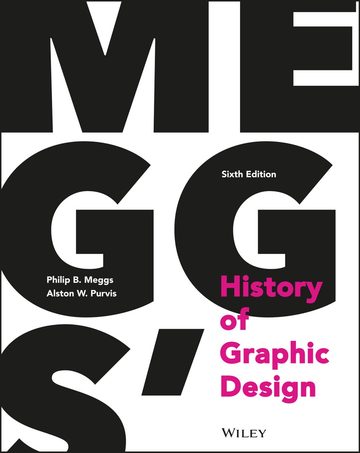
Talk to Meggs' History of Graphic Design like its author wrote you back.
Get the ideas that fit your life — not generic summaries.
- Chat with the book
- Audiobook-style main ideas
- Adapts to your life and goals
- Helps you take action
Meggs' History of Graphic Design, in detail
Meggs' History of Graphic Design is the standard reference text for the history of visual communication, covering the development of writing and printed images from prehistoric cave markings through the digital revolution. First published in 1983 and now in its fifth edition (with Alston W. Purvis), it traces how the tools and technologies of graphic communication — the alphabet, the printing press, photomechanical reproduction, digital composition — have shaped and been shaped by the cultures that produced them.
The book begins with the origins of writing in ancient Mesopotamia and Egypt, moves through the development of the Greek and Roman alphabets, the illuminated manuscripts of medieval Europe, and the decisive rupture of Gutenberg's moveable type in the fifteenth century. Each technological shift is analyzed in terms of both its technical mechanics and its social consequences. The printing press did not merely make books cheaper; it changed the relationship between knowledge and power, between individual authorship and collective tradition.
The core of the book covers the nineteenth and twentieth centuries, where graphic design as a professional discipline emerges. The Industrial Revolution created both mass printing and the typographic chaos that Arts and Crafts designers like William Morris reacted against. The European avant-gardes — the Bauhaus, De Stijl, Constructivism, the Swiss International Style — are treated in substantial detail, with analysis of specific designers and their characteristic solutions. Meggs is particularly strong on how ideological programs (functionalism, universalism, social utopianism) shaped formal decisions.
The American corporate design tradition, the New York School, the push from Swiss modernism to postmodern eclecticism, and early digital typography round out the history. The fifth edition extends coverage through the 1990s web era and early twenty-first century practice. The writing is clear and referential, the illustration program is extensive, and the bibliography is comprehensive. For students and practitioners of design, it functions as both a textbook and a permanent reference. Its limitation is that it is primarily a Western history — non-Western visual traditions appear mainly in the opening prehistoric chapters.
The big ideas
- 1.
Graphic design is as old as writing itself. The decisions early scribes made about form, legibility, and hierarchy are recognizably the same decisions contemporary designers make.
- 2.
The printing press was not just a technology but a revolution in information distribution. Its introduction to Europe in the mid-fifteenth century reshaped literacy, religion, science, and political authority within two generations.
- 3.
The Bauhaus synthesized craft, fine art, and industrial production into a unified design education model that still underlies most design curricula worldwide.
