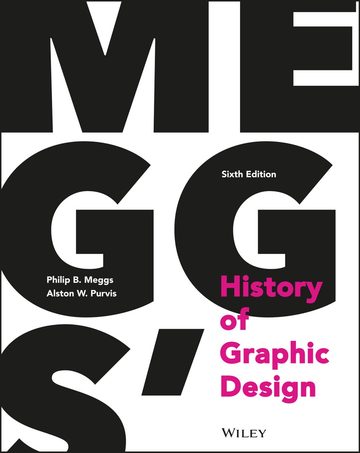
Meggs' History of Graphic Design by Philip B. Meggs is a 1983 history book about graphic design history, typography, visual communication. Graphic design is as old as writing itself. The decisions early scribes made about form, legibility, and hierarchy are recognizably the same decisions contemporary designers make.
Summary
Meggs' History of Graphic Design is the standard reference text for the history of visual communication, covering the development of writing and printed images from prehistoric cave markings through the digital revolution. First published in 1983 and now in its fifth edition (with Alston W. Purvis), it traces how the tools and technologies of graphic communication — the alphabet, the printing press, photomechanical reproduction, digital composition — have shaped and been shaped by the cultures that produced them.
The book begins with the origins of writing in ancient Mesopotamia and Egypt, moves through the development of the Greek and Roman alphabets, the illuminated manuscripts of medieval Europe, and the decisive rupture of Gutenberg's moveable type in the fifteenth century. Each technological shift is analyzed in terms of both its technical mechanics and its social consequences. The printing press did not merely make books cheaper; it changed the relationship between knowledge and power, between individual authorship and collective tradition.
The core of the book covers the nineteenth and twentieth centuries, where graphic design as a professional discipline emerges. The Industrial Revolution created both mass printing and the typographic chaos that Arts and Crafts designers like William Morris reacted against. The European avant-gardes — the Bauhaus, De Stijl, Constructivism, the Swiss International Style — are treated in substantial detail, with analysis of specific designers and their characteristic solutions. Meggs is particularly strong on how ideological programs (functionalism, universalism, social utopianism) shaped formal decisions.
The American corporate design tradition, the New York School, the push from Swiss modernism to postmodern eclecticism, and early digital typography round out the history. The fifth edition extends coverage through the 1990s web era and early twenty-first century practice. The writing is clear and referential, the illustration program is extensive, and the bibliography is comprehensive. For students and practitioners of design, it functions as both a textbook and a permanent reference. Its limitation is that it is primarily a Western history — non-Western visual traditions appear mainly in the opening prehistoric chapters.
Talk to Meggs' History of Graphic Design like its author wrote you back.
Get the ideas that fit your life — not generic summaries.
- Chat with the book
- Audiobook-style main ideas
- Adapts to your life and goals
- Helps you take action
Key takeaways
- 1.
Graphic design is as old as writing itself. The decisions early scribes made about form, legibility, and hierarchy are recognizably the same decisions contemporary designers make.
- 2.
The printing press was not just a technology but a revolution in information distribution. Its introduction to Europe in the mid-fifteenth century reshaped literacy, religion, science, and political authority within two generations.
- 3.
The Bauhaus synthesized craft, fine art, and industrial production into a unified design education model that still underlies most design curricula worldwide.
- 4.
The Swiss International Style — grid-based layouts, sans-serif typography, objective photography — emerged from a functionalist conviction that form should serve communication, not decorative impulse.
- 5.
Every technological shift in printing has initially produced chaos — a flood of bad work exploiting new possibilities — before a new aesthetic discipline emerged in response.
- 6.
Postmodern graphic design in the 1980s and 1990s rejected Modernism's universalism not out of nihilism but from a conviction that communication is always culturally specific, never neutral.
- 7.
The history of typography is inseparable from the history of ideas: changes in letterform, spacing, and layout have reflected and reinforced changing assumptions about knowledge, authority, and the reader.
Discussion questions
Use these on your own, with a book club, or as chat starters in Superbook. Book club version, ready to copy or print →
- 1.
Meggs argues that every major technology shift in printing eventually produced a backlash aesthetic. What parallels do you see in the reaction to digital typography and layout tools today?
- 2.
The Bauhaus believed design could serve social progress. How much of that belief survives in contemporary design culture, and where has it been abandoned?
- 3.
The book is primarily a Western history. What do you lose by treating calligraphy traditions from China, Japan, or the Islamic world mainly as background context rather than as parallel histories?
- 4.
Typography is described as a technology as much as an art. Do you find that framing helpful or limiting when thinking about typeface design?
- 5.
What is the design movement or period Meggs covers that feels most alive or relevant to the visual world you navigate today?
- 6.
William Morris and the Arts and Crafts movement were a reaction against the degraded quality of industrial printing. What contemporary movement, if any, plays a similar role?
- 7.
Swiss modernism claimed to produce neutral, objective communication. Is that claim defensible, or does every formal choice carry cultural assumptions?
- 8.
The book ends its original coverage around the early digital period. What would the chapters on 2000–2025 need to address that Meggs could not have anticipated?
- 9.
Graphic design is often treated as secondary to fine art in cultural hierarchies. Does reading a comprehensive history of the field change how you think about that ranking?
- 10.
What is the most formally interesting period of design history to you, and what makes it interesting — the forms themselves, the ideas behind them, or the historical pressures that produced them?
- 11.
Meggs connects formal changes in design directly to social and ideological shifts. Is that connection always convincing, or does it sometimes feel like post-hoc rationalization?
Themes
Frequently asked questions
-
Is Meggs' History of Graphic Design worth reading?
For design students and practitioners, it is essential. It is also a rewarding read for anyone interested in visual culture, the history of printing, or how ideas move through material form. Non-specialists may find the middle sections on avant-garde movements more demanding.
-
How long is Meggs' History of Graphic Design?
The fifth edition runs to over 600 pages with extensive illustration. At a scholarly pace that engages the images, it requires considerably more time than the word count suggests — plan for at least twenty hours of study rather than casual reading.
-
What edition should I read?
The fifth edition (2012, revised by Alston W. Purvis after Meggs's death in 2002) is the most current and extends coverage into the digital era. Earlier editions are still useful for the historical coverage, which is unchanged.
-
Who should read this book?
Graphic design students, practicing designers who want historical context, and readers interested in the cultural history of visual communication. It works as a course text and as a reference book to return to throughout a design career.
-
What's the most important concept in the book?
That graphic design is not decoration but a primary technology of civilization — the means by which knowledge has been preserved, transmitted, and contested since the invention of writing. Understanding its history makes every contemporary design decision more legible.