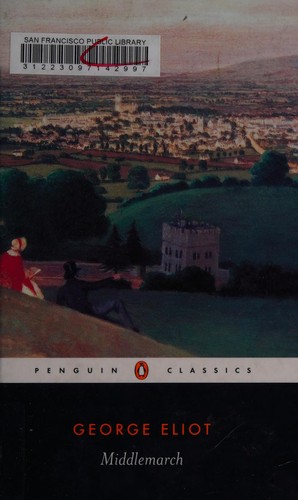
Talk to Middlemarch like its author wrote you back.
Get the ideas that fit your life — not generic summaries.
- Chat with the book
- Audiobook-style main ideas
- Adapts to your life and goals
- Helps you take action
What it argues
Middlemarch is the novel Virginia Woolf called the only English novel written for grown-up people, and the description is accurate if not entirely fair. Set in a fictional English Midlands town in the early 1830s, it tracks several intersecting lives across roughly two years: Dorothea Brooke, a serious-minded young woman who marries an elderly pedant because she mistakes him for an intellectual giant; Tertius Lydgate, a gifted physician whose medical ambitions are slowly consumed by a disastrous marriage and mounting debt; Fred Vincy, a young man of comfortable habits who has to learn what it means to earn something; and the politician Bulstrode, whose civic respectability conceals a past that eventually surfaces.
George Eliot's central argument — distributed across a thousand pages — is that most of what determines the quality of a life happens in small, unrecorded choices rather than great dramatic moments. The novel's famous Prelude compares Dorothea to Saint Theresa and asks what happens to a woman of that temperament born in a time and place that has no use for her kind of idealism. The answer the novel gives is: she gets married, she suffers, she adjusts, and she does more good in the world than she knows, through actions too small and undramatic to be remembered. This is both consoling and devastating, and Eliot seems to know it.
What it gets right
- 1.
The novel's core proposition: most lives are shaped not by extraordinary choices but by accumulated small ones, and the world is better or worse for private acts of goodness that leave no historical record.
- 2.
Dorothea's arc is about the cost of idealism in a world that has no adequate use for it — and about what becomes of that idealism when it has to inhabit an ordinary life.
- 3.
Lydgate's story is a study in how a gifted person can be destroyed by a single sustained failure of judgment — in his case, about Rosamond — and how pride makes that destruction worse.
What it covers
Who wrote it
George Eliot was the pen name of Mary Ann Evans (1819–1880), an English novelist, poet, journalist, and translator. She adopted a male pseudonym to ensure her work was taken seriously. Her major novels include Adam Bede, The Mill on the Floss, Silas Marner, and Middlemarch, which was published in eight installments in 1871–72. Eliot lived openly with the philosopher George Henry Lewes, who was legally unable to divorce his wife — a social arrangement that cost her many social relationships but did not diminish her reputation as the greatest English novelist of her time.
