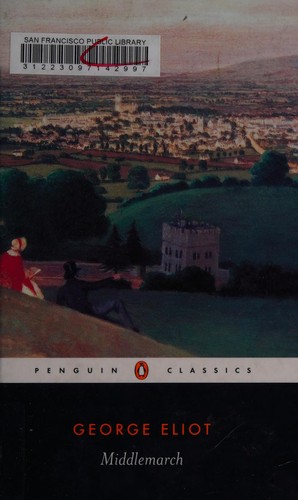
Middlemarch by George Eliot is a 1871 classics book about idealism and compromise, marriage and self-determination, provincial society and ambition. The novel's core proposition: most lives are shaped not by extraordinary choices but by accumulated small ones, and the world is better or worse for private acts of goodness that leave no historical record.
Summary
Middlemarch is the novel Virginia Woolf called the only English novel written for grown-up people, and the description is accurate if not entirely fair. Set in a fictional English Midlands town in the early 1830s, it tracks several intersecting lives across roughly two years: Dorothea Brooke, a serious-minded young woman who marries an elderly pedant because she mistakes him for an intellectual giant; Tertius Lydgate, a gifted physician whose medical ambitions are slowly consumed by a disastrous marriage and mounting debt; Fred Vincy, a young man of comfortable habits who has to learn what it means to earn something; and the politician Bulstrode, whose civic respectability conceals a past that eventually surfaces.
George Eliot's central argument — distributed across a thousand pages — is that most of what determines the quality of a life happens in small, unrecorded choices rather than great dramatic moments. The novel's famous Prelude compares Dorothea to Saint Theresa and asks what happens to a woman of that temperament born in a time and place that has no use for her kind of idealism. The answer the novel gives is: she gets married, she suffers, she adjusts, and she does more good in the world than she knows, through actions too small and undramatic to be remembered. This is both consoling and devastating, and Eliot seems to know it.
The prose is unlike anything before it in English fiction: philosophical, analytic, deeply interested in the gap between what characters believe about themselves and what is actually happening to them. The narrator is a constant, wry, compassionate presence, capable of zooming from a character's private thought to a sociological observation about the whole of English provincial life in a single paragraph. Reading Middlemarch is more like reading a very long essay that has been brilliantly novelized than like reading a conventional plot-driven narrative.
This is a long, dense book. Reading it is not always comfortable. Some of Dorothea's choices will frustrate modern readers who want her to act. Casaubon, her husband, is so accurately rendered as an intellectual bully that spending time in his company is genuinely unpleasant. But for readers willing to give it time — and it requires sustained time — Middlemarch pays back more per page than almost any English novel.
Talk to Middlemarch like its author wrote you back.
Get the ideas that fit your life — not generic summaries.
- Chat with the book
- Audiobook-style main ideas
- Adapts to your life and goals
- Helps you take action
Key takeaways
- 1.
The novel's core proposition: most lives are shaped not by extraordinary choices but by accumulated small ones, and the world is better or worse for private acts of goodness that leave no historical record.
- 2.
Dorothea's arc is about the cost of idealism in a world that has no adequate use for it — and about what becomes of that idealism when it has to inhabit an ordinary life.
- 3.
Lydgate's story is a study in how a gifted person can be destroyed by a single sustained failure of judgment — in his case, about Rosamond — and how pride makes that destruction worse.
- 4.
Casaubon is one of fiction's great studies in intellectual vanity. His tragedy is that he suspects his work is worthless and cannot admit it, even to himself.
- 5.
George Eliot's narrator is a philosophical presence, not just a storytelling device. The authorial commentary is as important as the plot.
- 6.
The novel shows how money — specifically debt and insufficient income — shapes every major character's choices in ways they rarely acknowledge directly.
- 7.
Marriage in the novel is a site of genuine moral inquiry. Eliot is interested not in whether marriages are happy but in what they require and what they cost.
- 8.
Rosamond Vincy is not the conventional villain she's often described as. She is a person who was given exactly the wrong education for the life she's trying to live. The novel extends some sympathy to that.
- 9.
The ending refuses grand resolution. Dorothea's 'unhistoric acts' — the phrase from the final paragraph — are the novel's answer to the question of what one life amounts to.
Discussion questions
Use these on your own, with a book club, or as chat starters in Superbook. Book club version, ready to copy or print →
- 1.
Eliot's Prelude compares Dorothea to Saint Theresa and implies she has no adequate arena for her ambitions. Do you think the novel resolves that problem for Dorothea, or does it leave her diminished?
- 2.
Casaubon's point of view is given at length and with compassion in some chapters. Does access to his perspective change how you judge him, or does it confirm the judgment?
- 3.
Lydgate is presented as a serious scientist with genuine gifts. How does his marriage to Rosamond destroy him, and how much does his own character make that destruction inevitable?
- 4.
Rosamond is the novel's most disliked character among many readers. Is she the villain of Lydgate's story, a victim of her own upbringing, or something the novel refuses to simplify?
- 5.
Will Ladislaw is often called the novel's weakest element. Do you find him a credible love interest for Dorothea, or does he feel underdeveloped compared to the rest of the cast?
- 6.
The novel argues that goodness consists largely in private, unrecorded acts that make things slightly better for the people around you. Is that inspiring, or is there something sad about it?
- 7.
Bulstrode's past catches up with him. Is his punishment proportionate? Does the novel treat religious hypocrisy differently from other forms of hypocrisy?
- 8.
Fred Vincy's arc is the most conventional in the novel — he learns responsibility and earns the woman who refused him. Does it feel thin compared to the other plots, or does its ordinariness make a point?
- 9.
The town of Middlemarch itself — its gossip, hierarchies, politics — functions almost as a character. How does the community shape individual outcomes? Is Eliot critical of it?
- 10.
Dorothea's second marriage, which many readers find frustrating or worse, is framed by the novel as her choice. How do you read it?
- 11.
The final paragraph says Dorothea's influence on those around her was real but 'unhistoric.' Is that meant as consolation or as Eliot's honest assessment of what women's lives in that period amounted to?
- 12.
Middlemarch is often called the greatest English novel. Having read it, do you agree? What would you put against it?
- 13.
The novel was serialized in eight parts over 1871-72. Does it feel like a serialized novel to you — are there moments that feel like mini-climaxes designed to hold readers from one installment to the next?
Themes
Frequently asked questions
-
Is Middlemarch worth reading?
Yes, but it demands time and patience. It is slow to start, long, and dense with narrator commentary. Readers who stay with it consistently report it as one of the most rewarding reading experiences in English fiction. If you've tried once and bounced off, try again later in life.
-
Is Middlemarch hard to read?
Yes, in the sense of being long and intellectually demanding. The prose is complex but not obscure — it rewards slow reading. The main obstacle is length: at over 800 pages, it requires sustained commitment. Most readers find it easier to read in dedicated sessions than in fragments.
-
What is Middlemarch about without spoilers?
Several interconnected lives in a provincial English town in the early 19th century — an idealistic young woman in a bad marriage, an ambitious doctor whose private life undoes his public ambitions, a corrupt civic reformer, and a young man learning to take his life seriously. The novel's real subject is what ordinary lives amount to.
-
Why is Middlemarch considered one of the greatest English novels?
Because of the quality and density of the thinking it contains — about character, society, marriage, ambition, and what constitutes a good life. The narrator's voice is unlike anything before or after it: both philosophical and deeply human. And the characters, particularly Dorothea and Lydgate, are among the most fully realized in fiction.
-
Who shouldn't read Middlemarch?
Readers who need plot momentum. Middlemarch moves very slowly by conventional standards, and the pleasures are intellectual and cumulative, not narrative. If you're looking for something that moves like a Victorian thriller, look elsewhere.
-
Is there a good adaptation of Middlemarch?
The 1994 BBC miniseries is well-regarded and covers the main plots with reasonable fidelity. It's a useful companion to the novel but not a substitute.