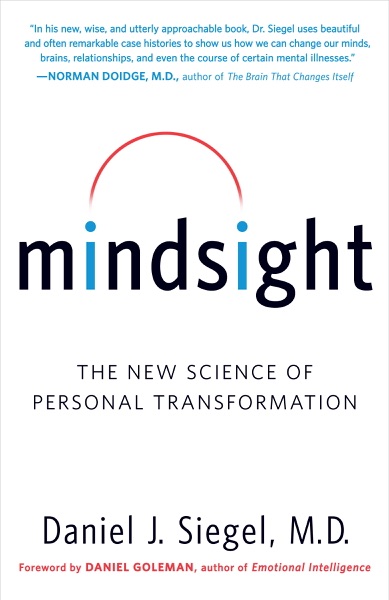
Talk to Mindsight: The New Science of Personal Transformation like its author wrote you back.
Get the ideas that fit your life — not generic summaries.
- Chat with the book
- Audiobook-style main ideas
- Adapts to your life and goals
- Helps you take action
Mindsight: The New Science of Personal Transformation, in detail
Mindsight is Daniel Siegel's case that humans have a distinct capacity he calls "mindsight" — the ability to sense and shape one's own mental processes and to perceive the inner lives of others. Siegel, a clinical psychiatrist at UCLA, argues that this skill is not fixed at birth but trainable, and that developing it changes the brain in measurable ways. The book draws on two decades of clinical work, neuroscience research, and his own model of interpersonal neurobiology to explain how the mind, brain, and relationships are inseparable.
The central framework is the integration of neural systems. Siegel argues that mental health, close relationships, and emotional resilience all depend on how well different parts of the brain — particularly the prefrontal cortex and the limbic system — are linked and communicating. When integration breaks down, people become either rigidly fixed or chaotically reactive. Mindsight is the practice of building integration by observing the mind with enough clarity to see where the linkages are broken.
Siegel presents this through a series of patient cases. A man paralyzed by rage after a family tragedy. A woman whose childhood neglect left her unable to access her own emotions. A couple locked in repetitive conflict neither could explain. Each case illustrates how early attachment experiences wire the brain, how those patterns show up in adult life, and how therapeutic insight — combined with specific reflective practices — can rewire them. The writing is clinical enough to be credible but plain enough to follow without a neuroscience background.
The book's practical offering is a set of mindfulness-based exercises for developing mindsight: the "Wheel of Awareness" meditation, narrative exercises for processing traumatic memories, and techniques for noticing emotional activation before it takes over. Siegel frames therapy as a special kind of relationship in which the therapist's regulated nervous system literally helps co-regulate the patient's, a process he grounds in mirror neuron research. Readers without access to therapy can still apply the framework to their own reflective practice, though the book is most useful to clinicians, parents, and anyone seeking to understand the science behind emotional development.
The big ideas
- 1.
Mindsight is the ability to observe your own mental processes — thoughts, feelings, memories — without being swept away by them. This skill can be trained.
- 2.
Integration of separate brain circuits is the hallmark of mental health. Rigidity or chaos in behavior often signals that integration has broken down.
- 3.
Early attachment relationships literally shape the developing brain. The patterns wired in childhood continue to run in adult relationships until made conscious.
