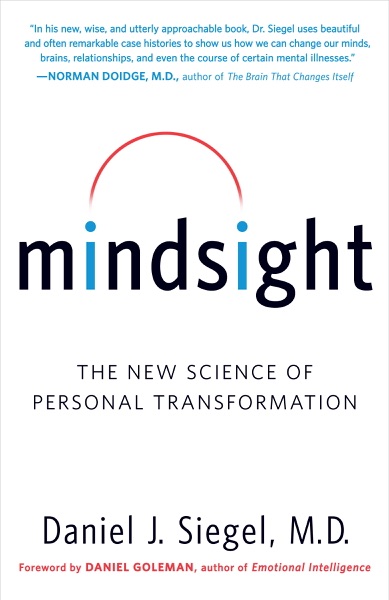
Mindsight: The New Science of Personal Transformation by Daniel J. Siegel is a 2010 psychology book about neuroscience, self-awareness, emotional regulation. Mindsight is the ability to observe your own mental processes — thoughts, feelings, memories — without being swept away by them. This skill can be trained.
Summary
Mindsight is Daniel Siegel's case that humans have a distinct capacity he calls "mindsight" — the ability to sense and shape one's own mental processes and to perceive the inner lives of others. Siegel, a clinical psychiatrist at UCLA, argues that this skill is not fixed at birth but trainable, and that developing it changes the brain in measurable ways. The book draws on two decades of clinical work, neuroscience research, and his own model of interpersonal neurobiology to explain how the mind, brain, and relationships are inseparable.
The central framework is the integration of neural systems. Siegel argues that mental health, close relationships, and emotional resilience all depend on how well different parts of the brain — particularly the prefrontal cortex and the limbic system — are linked and communicating. When integration breaks down, people become either rigidly fixed or chaotically reactive. Mindsight is the practice of building integration by observing the mind with enough clarity to see where the linkages are broken.
Siegel presents this through a series of patient cases. A man paralyzed by rage after a family tragedy. A woman whose childhood neglect left her unable to access her own emotions. A couple locked in repetitive conflict neither could explain. Each case illustrates how early attachment experiences wire the brain, how those patterns show up in adult life, and how therapeutic insight — combined with specific reflective practices — can rewire them. The writing is clinical enough to be credible but plain enough to follow without a neuroscience background.
The book's practical offering is a set of mindfulness-based exercises for developing mindsight: the "Wheel of Awareness" meditation, narrative exercises for processing traumatic memories, and techniques for noticing emotional activation before it takes over. Siegel frames therapy as a special kind of relationship in which the therapist's regulated nervous system literally helps co-regulate the patient's, a process he grounds in mirror neuron research. Readers without access to therapy can still apply the framework to their own reflective practice, though the book is most useful to clinicians, parents, and anyone seeking to understand the science behind emotional development.
Talk to Mindsight: The New Science of Personal Transformation like its author wrote you back.
Get the ideas that fit your life — not generic summaries.
- Chat with the book
- Audiobook-style main ideas
- Adapts to your life and goals
- Helps you take action
Key takeaways
- 1.
Mindsight is the ability to observe your own mental processes — thoughts, feelings, memories — without being swept away by them. This skill can be trained.
- 2.
Integration of separate brain circuits is the hallmark of mental health. Rigidity or chaos in behavior often signals that integration has broken down.
- 3.
Early attachment relationships literally shape the developing brain. The patterns wired in childhood continue to run in adult relationships until made conscious.
- 4.
The prefrontal cortex integrates information from the body, the limbic system, and the social world. Developing this integration is what therapy, meditation, and reflective relationships accomplish.
- 5.
Narrative coherence — the ability to tell a clear, integrated story of your own life including its painful parts — is one of the strongest predictors of secure attachment in your own children.
- 6.
The Wheel of Awareness meditation distinguishes the 'hub' of open awareness from the 'rim' of particular sensations, emotions, and thoughts. This distinction is the basis of mindsight practice.
- 7.
Relationships are not just social experiences; they are neurobiological events. Being in resonance with another person's mind activates shared neural circuits and co-regulates the nervous system.
- 8.
Trauma and neglect don't just create psychological problems; they produce measurable structural differences in the brain that therapeutic relationships and reflective practice can begin to reverse.
Discussion questions
Use these on your own, with a book club, or as chat starters in Superbook. Book club version, ready to copy or print →
- 1.
Siegel argues that observing your mental states without being controlled by them is a trainable skill. What situations in your life make that kind of observation most difficult?
- 2.
Think about a significant relationship pattern that keeps recurring in your life. What early experiences might have wired it into place?
- 3.
The book links narrative coherence — how well you can tell the story of your own life — to parenting quality. How would you rate the coherence of your own autobiography right now?
- 4.
Siegel describes integration as the key to mental health. Where in your emotional life do you experience the most rigidity? The most chaos?
- 5.
The Wheel of Awareness separates open awareness from specific mental contents. Have you had experiences that feel like accessing that 'hub'? What were the conditions?
- 6.
Siegel's cases often involve people who can't feel their own emotions or can't stop feeling them. Which direction is more familiar to you, and how does it affect your relationships?
- 7.
The book claims that a therapist's regulated nervous system can help co-regulate a patient's. Have you noticed anyone in your life who has a similar stabilizing effect on you? What do they do differently?
- 8.
Siegel argues that mindsight practice changes the physical brain. Does that framing — neurobiology rather than just 'self-awareness' — change how seriously you take practices like meditation or journaling?
- 9.
Early attachment patterns are powerful, but the book is fundamentally optimistic about change. What evidence from your own life suggests that old patterns can be rewired?
- 10.
How does Siegel's framework change the way you think about someone in your life who behaves in ways that seem self-destructive or inexplicable?
- 11.
The book treats relationships as neurobiological events, not just social ones. Does that framing make relationships feel more or less meaningful to you?
- 12.
If you tried the Wheel of Awareness meditation and distinguished your sense of awareness from its contents, what would you find at the hub?
Themes
Frequently asked questions
-
What is mindsight according to Daniel Siegel?
Mindsight is Siegel's term for the ability to perceive your own mind — thoughts, feelings, impulses — with enough clarity to understand them rather than simply act them out. He also uses it to describe the capacity to sense the inner life of another person. He argues both capacities depend on integrated brain function and can be developed.
-
Is Mindsight worth reading if I'm not in therapy?
Yes, though the book is most immediately useful to people in or considering therapy, or to clinicians and parents. The Wheel of Awareness and other reflective practices are accessible to anyone. Readers without a psychology background may find some of the neuroscience dense, but the patient case studies make the ideas concrete.
-
How does Mindsight relate to mindfulness meditation?
Siegel treats mindfulness as a primary tool for developing mindsight. The Wheel of Awareness is his own meditation framework, designed to cultivate the separation between the observing mind and its contents. He cites research showing that regular mindfulness practice changes the structure of the prefrontal cortex in ways that support emotional regulation.
-
What is interpersonal neurobiology?
It is a framework Siegel developed that treats the mind, brain, and relationships as a single integrated system. The central claim is that relationships — particularly early attachment relationships — literally shape the physical development of the brain, and that therapeutic or reflective relationships can continue to reshape it throughout life.
-
Who should read Mindsight?
Therapists, parents, and anyone who has noticed themselves repeating emotional patterns they can't seem to escape. It is also relevant for people interested in the neuroscience of meditation and self-awareness. Readers looking for a quick self-help fix may be frustrated by the clinical depth.