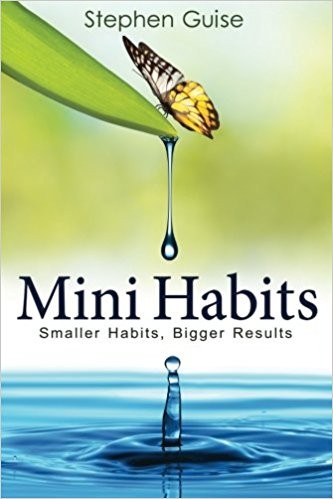
Talk to Mini Habits like its author wrote you back.
Get the ideas that fit your life — not generic summaries.
- Chat with the book
- Audiobook-style main ideas
- Adapts to your life and goals
- Helps you take action
What it argues
Mini Habits is Stephen Guise's case for starting habits so small they are almost impossible to fail. The central premise is that the biggest obstacle to building habits isn't laziness or lack of motivation — it's the brain's resistance to unfamiliar routines. Guise stumbled onto the core idea when he challenged himself to do one push-up. Just one. Not as a joke, but as the actual daily goal. What followed was six months of regular exercise that he had never managed to achieve with more ambitious plans.
The key insight is the distinction between willpower and motivation. Motivation is unreliable — it spikes and crashes, and setting habits that require high motivation guarantees failure on the days when motivation is low. Willpower, by contrast, can be deployed in tiny amounts. A mini habit is a required daily action so small that it requires almost no willpower to complete. One push-up. Write fifty words. Read one page. The goal is not the mini habit itself but the momentum it creates. Once you've done one push-up, you usually keep going. But the commitment is only to the one.
What it gets right
- 1.
Mini habits are required daily actions so small that they demand almost no willpower. Their purpose is consistency, not accomplishment — once started, you usually continue.
- 2.
Motivation is unreliable and shouldn't be the engine of habit formation. Willpower is more consistent but finite; mini habits use so little of it that you always have enough.
- 3.
Habits form through consistent repetition, not through intensity. A tiny action done every day builds neural pathways that a large action done occasionally does not.
What it covers
Who wrote it
Stephen Guise is an American writer and blogger based in the United States. He began writing about personal development at Deep Existence in 2011 and developed the mini habits concept after finding that aggressive habit-building programs repeatedly failed him. Mini Habits, published in 2013, became a self-publishing success and was translated into over twenty languages. Guise followed it with Mini Habits for Weight Loss (2016) and How to Be an Imperfectionist (2015), extending the low-resistance framework to related domains. He writes about behavior and personal development for a general audience.
