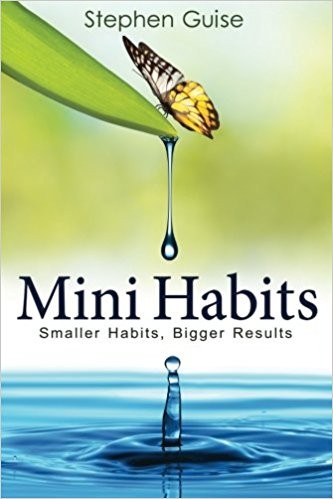
Mini Habits by Stephen Guise is a 2013 self-help book about habits, behavior change, motivation. Mini habits are required daily actions so small that they demand almost no willpower. Their purpose is consistency, not accomplishment — once started, you usually continue.
Summary
Mini Habits is Stephen Guise's case for starting habits so small they are almost impossible to fail. The central premise is that the biggest obstacle to building habits isn't laziness or lack of motivation — it's the brain's resistance to unfamiliar routines. Guise stumbled onto the core idea when he challenged himself to do one push-up. Just one. Not as a joke, but as the actual daily goal. What followed was six months of regular exercise that he had never managed to achieve with more ambitious plans.
The key insight is the distinction between willpower and motivation. Motivation is unreliable — it spikes and crashes, and setting habits that require high motivation guarantees failure on the days when motivation is low. Willpower, by contrast, can be deployed in tiny amounts. A mini habit is a required daily action so small that it requires almost no willpower to complete. One push-up. Write fifty words. Read one page. The goal is not the mini habit itself but the momentum it creates. Once you've done one push-up, you usually keep going. But the commitment is only to the one.
Guise argues that this approach works psychologically because it bypasses the brain's resistance to change. The basal ganglia, which handles automatic behavior, needs repetition to build a routine. Arbitrary large goals don't help it — consistent small triggers do. By lowering the bar to nearly zero, mini habits make the trigger-routine-reward loop easy to complete on any day, including bad ones. The consistency produces neural change that larger, irregular efforts don't.
The book is short and repeats its core argument several times from different angles. It works best as a corrective for people who have failed repeatedly with more ambitious habit frameworks and want to understand why. The method's main limitation is that it doesn't scale well for skills that require sustained practice to develop: a mini habit of reading one page will build a reading habit, but it won't necessarily build knowledge if you rarely get past the first page.
Talk to Mini Habits like its author wrote you back.
Get the ideas that fit your life — not generic summaries.
- Chat with the book
- Audiobook-style main ideas
- Adapts to your life and goals
- Helps you take action
Key takeaways
- 1.
Mini habits are required daily actions so small that they demand almost no willpower. Their purpose is consistency, not accomplishment — once started, you usually continue.
- 2.
Motivation is unreliable and shouldn't be the engine of habit formation. Willpower is more consistent but finite; mini habits use so little of it that you always have enough.
- 3.
Habits form through consistent repetition, not through intensity. A tiny action done every day builds neural pathways that a large action done occasionally does not.
- 4.
The 'too small to fail' design is the point: on your worst days, you still complete the habit, and the streak continues. Streaks and consistency are what create automatic behavior.
- 5.
Bonus reps are psychologically important. You commit to one push-up, then do twenty more. The commitment is honored; the bonus effort is a gift, not an obligation.
- 6.
Feelings of failure from missed ambitious habits damage future motivation. Mini habits prevent the shame spiral by making failure nearly impossible by design.
- 7.
The goal is to become someone who does the habit, not just someone who completed a task today. Identity change comes from accumulated small actions, not from single large efforts.
Discussion questions
Use these on your own, with a book club, or as chat starters in Superbook. Book club version, ready to copy or print →
- 1.
Guise's one-push-up story is the founding anecdote. Have you ever accidentally discovered that starting absurdly small worked better than starting with the 'right' amount of effort?
- 2.
He argues that motivation is an unreliable engine for habit formation. Think of a habit you've tried to build using motivation spikes — what happened when the spike passed?
- 3.
Mini habits work partly because they make streaks easy to maintain. How important is the unbroken-streak feeling to you personally, and does it help or create its own pressure?
- 4.
He distinguishes between 'motivation-based' and 'willpower-based' habit strategies. Which one have you historically relied on, and how has that worked?
- 5.
What's the smallest version of a habit you actually want to build? Could you honestly commit to doing only that minimum every day, even on your hardest days?
- 6.
The book argues consistency matters more than intensity. Where in your life might this principle apply outside of formal habits — relationships, creative work, exercise?
- 7.
Guise says most people set habits at a level that requires high-motivation days to sustain. What assumptions about effort and difficulty drove your last failed habit attempt?
- 8.
Mini habits are designed to build automatic behavior over time. Once a mini habit became automatic for you, did you raise the goal or was the automaticity itself the reward?
- 9.
The method has limits for skill-building where breadth requires volume. Where do you think mini habits are the right tool, and where might a different approach be more appropriate?
- 10.
He uses neuroscience to support the method. How much does the scientific framing change how you think about the advice compared to if it were presented as pure anecdote?
- 11.
If you designed a mini habit for the area of life you most want to improve right now, what would it be, and what would 'completion' look like on your worst day?
Themes
Frequently asked questions
-
Is Mini Habits worth reading?
Worth reading if you've failed with standard habit advice and want to understand why. The core idea is sound and useful. The book is short enough (about 130 pages) that the time investment is low, though the central argument is largely made by chapter four and the rest is reinforcement.
-
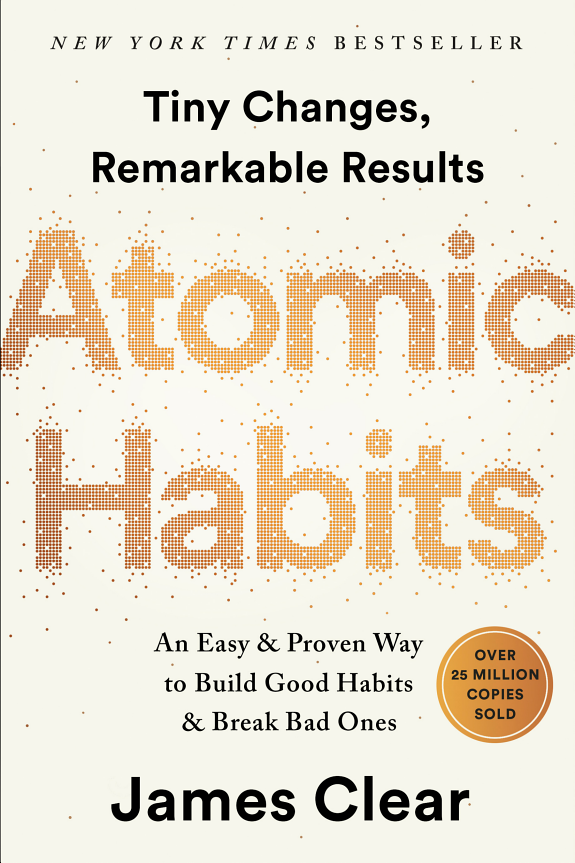
How is Mini Habits different from Atomic Habits?
Mini Habits focuses almost entirely on one mechanism — making the habit so small it can't fail — while Atomic Habits covers a broader framework including cue design, environment, identity, and reward. Mini Habits goes deeper on the motivational psychology of starting; Atomic Habits gives you more tools overall.
-
How long does it take to read Mini Habits?
About two hours for the roughly 130-page book. It's written accessibly and moves quickly. Some readers find it repetitive and skim the latter chapters once the core idea is clear.
-
What is a mini habit in practice?
A required daily action small enough to take thirty seconds or less on a bad day. One push-up. Write one sentence. Meditate for one breath. The minimum is set deliberately low so it survives days with no time, energy, or motivation. Doing more is always fine — it's just not required.
-
Who should read Mini Habits?
People who have tried standard habit-building approaches — streaks, habit stacks, large commitments — and found they collapse whenever life gets hard. The book is especially useful for anyone whose self-talk around habits includes a lot of shame about failure.