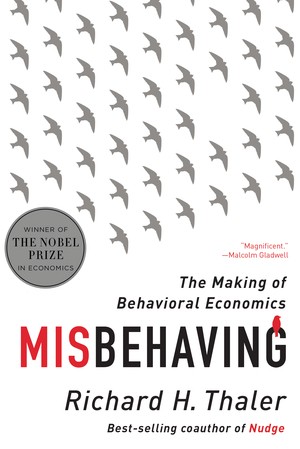
Talk to Misbehaving: The Making of Behavioral Economics like its author wrote you back.
Get the ideas that fit your life — not generic summaries.
- Chat with the book
- Audiobook-style main ideas
- Adapts to your life and goals
- Helps you take action
What it argues
Richard Thaler is one of the founders of behavioral economics, the field that took the anomalies in standard economic theory seriously rather than dismissing them as noise. Misbehaving, published in 2015, is his memoir of that project — how he built a career studying the gaps between how economists assumed people would behave and how people actually behaved, and how that work eventually won him the Nobel Prize in Economics in 2017.
The book opens with the concept of the Econ — the fictional perfectly rational agent of economic theory, who knows all relevant information, processes it correctly, has stable preferences, and maximizes utility consistently. Thaler spent his career documenting that humans are not Econs. They overspend money already spent (sunk cost fallacy), value something more highly once they own it than before (endowment effect), treat equivalent amounts of money differently depending on where they come from (mental accounting), and care about fairness even at economic cost to themselves.
What it gets right
- 1.
The Econ is a fiction. Standard economic theory assumes rational agents who maximize utility consistently. Behavioral economics began by taking seriously the systematic deviations from this model.
- 2.
Mental accounting means people treat equivalent sums of money differently based on where they come from, how they were earned, or what account they are mentally placed in.
- 3.
The endowment effect: people value something more once they own it than before acquiring it, even when no objective change has occurred. This violates the standard assumption that willingness to accept equals willingness to pay.
What it covers
Who wrote it
Richard H. Thaler is Charles R. Walgreen Distinguished Service Professor of Behavioral Science and Economics at the University of Chicago Booth School of Business. He won the Nobel Prize in Economics in 2017 for his contributions to behavioral economics. He co-authored Nudge with Cass Sunstein, which became one of the most influential books in behavioral public policy. His earlier work on mental accounting, the endowment effect, and the sunk cost fallacy helped establish that systematic deviations from economic rationality required explanation rather than dismissal.
