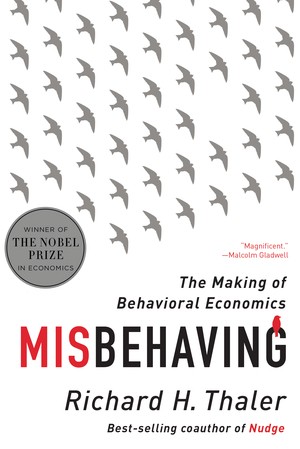
Misbehaving: The Making of Behavioral Economics by Richard H. Thaler is a 2015 psychology book about behavioral economics, decision-making, cognitive bias. The Econ is a fiction. Standard economic theory assumes rational agents who maximize utility consistently. Behavioral economics began by taking seriously the systematic deviations from this model.
Summary
Richard Thaler is one of the founders of behavioral economics, the field that took the anomalies in standard economic theory seriously rather than dismissing them as noise. Misbehaving, published in 2015, is his memoir of that project — how he built a career studying the gaps between how economists assumed people would behave and how people actually behaved, and how that work eventually won him the Nobel Prize in Economics in 2017.
The book opens with the concept of the Econ — the fictional perfectly rational agent of economic theory, who knows all relevant information, processes it correctly, has stable preferences, and maximizes utility consistently. Thaler spent his career documenting that humans are not Econs. They overspend money already spent (sunk cost fallacy), value something more highly once they own it than before (endowment effect), treat equivalent amounts of money differently depending on where they come from (mental accounting), and care about fairness even at economic cost to themselves.
Mental accounting is one of Thaler's signature contributions. Money is fungible in economic theory — a dollar is a dollar, regardless of its source or intended use. In practice, people maintain separate mental accounts for different pots of money and treat them as distinct. Tax refund money gets spent differently than paycheck money. The house money effect in gambling comes from treating winnings as a separate, more expendable account. Understanding mental accounting allows designers of retirement plans, saving programs, and tax policy to work with rather than against these tendencies.
The second half of the book covers the policy application that Thaler co-developed with Cass Sunstein: libertarian paternalism, or nudge. If people make predictable errors, the question is whether defaults and choice architecture can be designed to produce better outcomes while preserving freedom of choice. Automatic enrollment in 401(k) plans is the canonical example: most people do not opt in when they have to act, but most people stay enrolled when they have to opt out. The outcome is dramatically better retirement savings without any mandate. Misbehaving is the most accessible and readable account of how behavioral economics developed and why it matters.
Talk to Misbehaving: The Making of Behavioral Economics like its author wrote you back.
Get the ideas that fit your life — not generic summaries.
- Chat with the book
- Audiobook-style main ideas
- Adapts to your life and goals
- Helps you take action
Key takeaways
- 1.
The Econ is a fiction. Standard economic theory assumes rational agents who maximize utility consistently. Behavioral economics began by taking seriously the systematic deviations from this model.
- 2.
Mental accounting means people treat equivalent sums of money differently based on where they come from, how they were earned, or what account they are mentally placed in.
- 3.
The endowment effect: people value something more once they own it than before acquiring it, even when no objective change has occurred. This violates the standard assumption that willingness to accept equals willingness to pay.
- 4.
Loss aversion is asymmetric: losses hurt roughly twice as much as equivalent gains feel good. Combined with mental accounting, this drives a wide range of economic irrationalities.
- 5.
Fairness matters economically. People reject offers they consider unfair even at cost to themselves, which the ultimatum game demonstrates repeatedly across cultures.
- 6.
Nudge: small changes in how choices are presented — defaults, framing, salience — have large effects on behavior. Automatic enrollment increases retirement savings dramatically without any mandate.
- 7.
Present bias means people discount near-term costs and rewards very steeply compared to distant ones, which is why saving for retirement, diet, and exercise are persistently difficult despite stated intentions.
- 8.
The sunk cost fallacy describes the tendency to continue investing in a failing project because of what has already been spent rather than because of expected future returns.
Discussion questions
Use these on your own, with a book club, or as chat starters in Superbook. Book club version, ready to copy or print →
- 1.
Thaler describes the Econ as a useful fiction that became a harmful assumption. In what domains in your life do you think you approximate an Econ, and in what domains are you clearly something different?
- 2.
Mental accounting means you treat your tax refund differently from your paycheck even though they are equally real dollars. Can you trace your own mental accounts and how they affect your spending?
- 3.
The endowment effect — valuing things more once you own them — has implications for negotiation, selling, and letting go of things. Where do you see it operating in your own decisions?
- 4.
Thaler argues that behavioral economics is more descriptively accurate than standard economics but that this does not mean people are stupid or incompetent. How does that framing change how you think about the people making predictable errors?
- 5.
Automatic enrollment in 401(k) plans is the nudge success story. What other decisions in your life would benefit from a better default?
- 6.
He discusses the ultimatum game: people reject unfair offers at cost to themselves. Does that finding change how you think about economic rationality, or does it just mean fairness preferences are part of utility?
- 7.
Misbehaving is partly a memoir of being an outsider within economics. What does it take to get a field to revise its foundational assumptions?
- 8.
Present bias makes it hard to commit to future-directed behavior — saving, diet, exercise. What commitments have you made that actually work for you, and what design features make them effective?
- 9.
Thaler won the Nobel Prize in 2017 for this work. What does the delay between the research in the 1980s and recognition in 2017 suggest about how paradigm shifts happen in academic fields?
- 10.
The nudge framework has been criticized as paternalistic even in its libertarian form. Do you think it is appropriate for governments and employers to design choice architecture to improve outcomes?
- 11.
Which behavioral anomaly that Thaler describes seems most exploitable by corporations or governments in ways that harm rather than help consumers?
Themes
Frequently asked questions
-
Is Misbehaving the same as Nudge?
Different books with overlapping content. Nudge, co-authored with Sunstein, focuses on policy applications of behavioral economics. Misbehaving is more autobiographical and covers the development of the field as Thaler lived it, from his early anomalies list through his Nobel.
-
What is the endowment effect?
The finding that people value an object more once they own it than before acquiring it. In experiments, people set a higher minimum selling price for mugs they have been given than they are willing to pay to acquire identical mugs. This violates the standard economic assumption of symmetric willingness to pay and accept.
-
Does behavioral economics prescribe solutions, or only diagnose problems?
Both. The nudge framework that Thaler and Sunstein developed is explicitly prescriptive: if people make predictable errors, choice architecture can be designed to produce better outcomes. Much of the policy application of behavioral economics is in default settings, framing, and commitment devices.
-
Do I need an economics background?
No. Thaler writes for a general audience and provides enough background to follow the arguments. An awareness of basic economic concepts helps but is not required.
-
What is the most important practical insight in the book?
That defaults matter enormously. When you have to actively opt in to a beneficial behavior, most people don't. When you are automatically enrolled and have to opt out, most people stay. Redesigning defaults is one of the highest-leverage interventions available to policy makers and institutional designers.
Similar books
Thinking, Fast and Slow
Daniel Kahneman
Noise: A Flaw in Human Judgment
Daniel Kahneman, Olivier Sibony, and Cass R. Sunstein
Nudge: Improving Decisions About Health, Wealth, and Happiness
Richard H. Thaler and Cass R. Sunstein
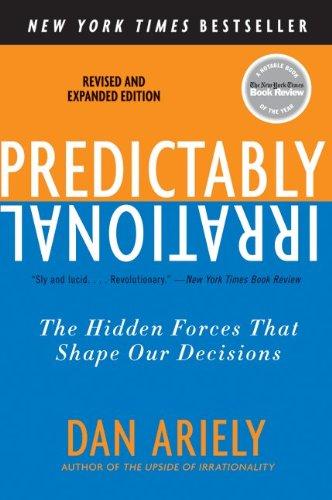
Predictably Irrational
Dan Ariely
