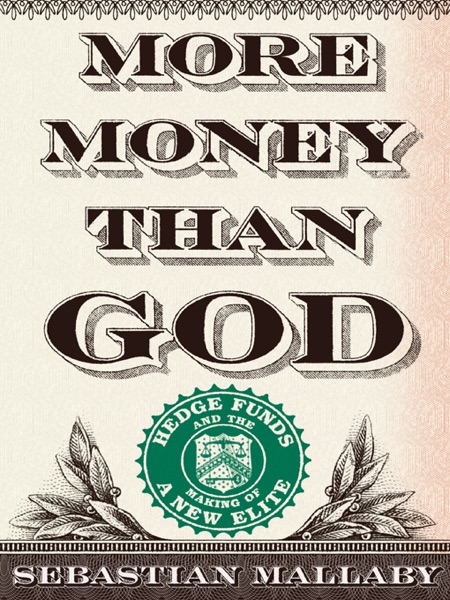
Talk to More Money Than God like its author wrote you back.
Get the ideas that fit your life — not generic summaries.
- Chat with the book
- Audiobook-style main ideas
- Adapts to your life and goals
- Helps you take action
What it argues
Sebastian Mallaby's history of hedge funds begins with Alfred Winslow Jones, who in 1949 invented the basic structure that still defines the industry: borrow money to buy what you think will go up, sell short what you think will go down, take a 20 percent cut of the profits. The book traces the industry from that origin through George Soros breaking the Bank of England in 1992, through Julian Robertson's Tiger Management, through the Long-Term Capital Management collapse of 1998, to the crisis of 2008 and beyond.
The central argument is counterintuitive. Mallaby's contention is that hedge funds — despite their opacity, their fees, and their occasional spectacular blowups — have generally been a stabilizing force in financial markets, not a destabilizing one. They make markets more efficient by trading against mispricing. They tend to be short when markets are euphoric and long when everyone else has fled. The firms that survived across decades did so by being right about things that consensus opinion had wrong, not by riding leverage into a bubble.
What it gets right
- 1.
Alfred Winslow Jones invented the hedge fund structure in 1949 — leveraged long positions offset by short sales, plus a performance fee — and most of what followed is variation on that original design.
- 2.
The best hedge funds make markets more efficient by taking the other side of crowd behavior. They buy when everyone is selling and short when everyone is buying, which tends toward stability rather than instability.
- 3.
George Soros's reflexivity theory holds that market prices influence the fundamentals they are supposed to reflect — creating feedback loops that standard efficient-market models ignore.
What it covers
Who wrote it
Sebastian Mallaby is a British-American journalist and author who is a senior fellow at the Council on Foreign Relations. He spent many years as a Washington Post columnist and editorial board member. In addition to More Money Than God, he wrote The Man Who Knew, a biography of Alan Greenspan, and The World Banker, about the World Bank. Mallaby was given extensive access to hedge fund managers and their records for this project. He is known for his ability to translate complex financial and economic subjects into narrative form for general readers.
