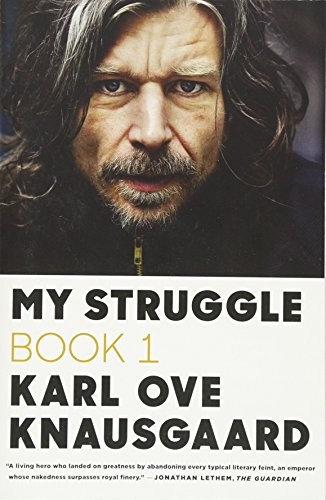
Talk to My Struggle: Book 1 like its author wrote you back.
Get the ideas that fit your life — not generic summaries.
- Chat with the book
- Audiobook-style main ideas
- Adapts to your life and goals
- Helps you take action
My Struggle: Book 1, in detail
My Struggle: Book 1 opens with a long meditation on death — the image of a dead face on television, the cultural rituals that hide corpses from view — before settling into what the book is actually about: Knausgaard's childhood in Norway in the 1970s and early 80s, and his adult journey to clean out the house where his alcoholic father died. The novel unfolds in enormous, unhurried paragraphs, cutting between the teenage Karl Ove and the forty-year-old man trying to understand what his father's life and death mean.
The book is less concerned with what happened than with how it felt. Knausgaard renders adolescence — the social anxiety, the desperate desire to be cool, the first drunk party, the embarrassing failures — with an almost clinical honesty that most writers sand down into easier shapes. The father, Kai Age, is a forbidding, cold presence who becomes pathetic and then simply absent; the novel's emotional center is the son's attempt to reckon with a man he feared but barely knew. There is no therapeutic resolution. The grief is real, the shame is real, the confusion is real.
What makes the book strange and compelling is its scale and texture. Knausgaard doesn't streamline or curate. He gives you the boring parts, the repetitions, the sensory minutiae of a specific place and time. The Norway he describes — the fjords, the ferries, the school corridors, the smell of beer on a father's breath — accumulates into something dense and particular. This isn't a novel in any conventional sense; it's a six-volume autobiography written in the form of fiction, and the opening book establishes its terms: everything included, nothing resolved.
Readers who find literary minimalism more comfortable than this kind of sprawling interiority may struggle. The book has almost no plot in the conventional sense. But readers willing to surrender to its pace will find something rare: prose that makes ordinary experience feel fully real rather than prettily symbolic. Whether the Hitlerian title is a provocation, a joke, or a serious claim about the struggle of self-examination remains usefully ambiguous throughout.
The big ideas
- 1.
Knausgaard treats embarrassment and shame as worthy of the same literary attention as tragedy, collapsing the hierarchy between significant and insignificant experience.
- 2.
The father-son dynamic at the book's center is built on distance and incomprehension rather than conflict, which turns out to be harder to write about than overt drama.
- 3.
Memory is rendered as unreliable and fragmentary, but felt as vivid and certain — the gap between those two conditions is where most of the book lives.
