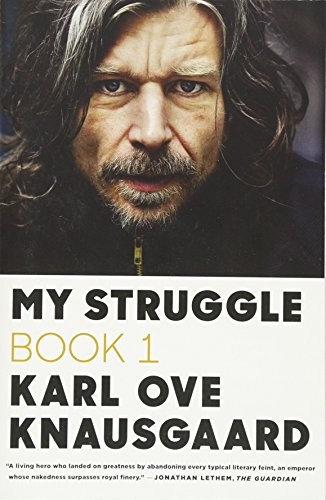
My Struggle: Book 1 by Karl Ove Knausgaard is a 2009 literary fiction book about memory and time, father and son, death and grief. Knausgaard treats embarrassment and shame as worthy of the same literary attention as tragedy, collapsing the hierarchy between significant and insignificant experience.
Summary
My Struggle: Book 1 opens with a long meditation on death — the image of a dead face on television, the cultural rituals that hide corpses from view — before settling into what the book is actually about: Knausgaard's childhood in Norway in the 1970s and early 80s, and his adult journey to clean out the house where his alcoholic father died. The novel unfolds in enormous, unhurried paragraphs, cutting between the teenage Karl Ove and the forty-year-old man trying to understand what his father's life and death mean.
The book is less concerned with what happened than with how it felt. Knausgaard renders adolescence — the social anxiety, the desperate desire to be cool, the first drunk party, the embarrassing failures — with an almost clinical honesty that most writers sand down into easier shapes. The father, Kai Age, is a forbidding, cold presence who becomes pathetic and then simply absent; the novel's emotional center is the son's attempt to reckon with a man he feared but barely knew. There is no therapeutic resolution. The grief is real, the shame is real, the confusion is real.
What makes the book strange and compelling is its scale and texture. Knausgaard doesn't streamline or curate. He gives you the boring parts, the repetitions, the sensory minutiae of a specific place and time. The Norway he describes — the fjords, the ferries, the school corridors, the smell of beer on a father's breath — accumulates into something dense and particular. This isn't a novel in any conventional sense; it's a six-volume autobiography written in the form of fiction, and the opening book establishes its terms: everything included, nothing resolved.
Readers who find literary minimalism more comfortable than this kind of sprawling interiority may struggle. The book has almost no plot in the conventional sense. But readers willing to surrender to its pace will find something rare: prose that makes ordinary experience feel fully real rather than prettily symbolic. Whether the Hitlerian title is a provocation, a joke, or a serious claim about the struggle of self-examination remains usefully ambiguous throughout.
Talk to My Struggle: Book 1 like its author wrote you back.
Get the ideas that fit your life — not generic summaries.
- Chat with the book
- Audiobook-style main ideas
- Adapts to your life and goals
- Helps you take action
Key takeaways
- 1.
Knausgaard treats embarrassment and shame as worthy of the same literary attention as tragedy, collapsing the hierarchy between significant and insignificant experience.
- 2.
The father-son dynamic at the book's center is built on distance and incomprehension rather than conflict, which turns out to be harder to write about than overt drama.
- 3.
Memory is rendered as unreliable and fragmentary, but felt as vivid and certain — the gap between those two conditions is where most of the book lives.
- 4.
The novel refuses catharsis. Grief doesn't produce insight; cleaning a dead man's house produces grime and exhaustion and a kind of numb endurance.
- 5.
Adolescent social anxiety — the desperate, humiliating need to belong — is described with an accuracy that most adult fiction is too dignified to attempt.
- 6.
Scale and accumulation are deliberate techniques. The boring parts are not editorially neglected; they are the argument.
- 7.
The first-person narrator's unreliability is never acknowledged directly, which forces the reader to hold two versions of events simultaneously.
- 8.
Writing about the self honestly requires a specific form of courage — or shamelessness — that Knausgaard insists is not the same thing as narcissism.
Discussion questions
Use these on your own, with a book club, or as chat starters in Superbook. Book club version, ready to copy or print →
- 1.
Knausgaard argues that hiding death — putting corpses in hospitals, making them invisible — has made us less able to live. Do you find this convincing, or is it a writer's conceit?
- 2.
The father is cold and frightening in childhood memory, pathetic and ruined by the time of his death. Does the book ask you to feel sympathy for him, or just to understand him?
- 3.
The title invokes Hitler's autobiography deliberately. Is that a provocation that illuminates the book, or an irritant that doesn't pay off?
- 4.
Knausgaard includes a great deal of material that most writers would cut. Does that feel like freedom or indulgence to you as a reader?
- 5.
The adolescent sections describe social desperation with unusual honesty. Did they ring true to your own experience of that age?
- 6.
The book is autobiography presented as a novel. Does the fictional frame matter, or is it just a legal/marketing distinction?
- 7.
Grief in this book is mainly experienced as practical work — cleaning, organizing, dealing with bureaucracy. Is that more or less honest than grief as emotional breakdown?
- 8.
Knausgaard rarely editorializes. He describes what happened and how it felt without telling you what to think. Is that restraint, or is it a form of evasion?
- 9.
The Norwegian setting is extremely specific — a particular climate, class, and cultural moment. How much does that specificity help or hinder a non-Norwegian reader?
- 10.
The book has been called both the most important European novel of the century and a self-indulgent diary. Is that disagreement meaningful, or are both readings partly correct?
- 11.
What do you think Knausgaard is actually claiming when he calls the experience of writing this a 'struggle'?
- 12.
Would you read the remaining five volumes? What would make you continue, and what might make you stop?
Themes
Frequently asked questions
-
Is My Struggle: Book 1 worth reading?
If you're willing to read slowly and surrender to accumulation, yes. The book is unlike most literary fiction in that it refuses to organize experience into meaning. What it offers instead is the sensation of another consciousness rendered with unusual honesty. If you need plot or forward momentum, it will frustrate you.
-
Is My Struggle hard to read?
Not linguistically — the prose is clear and Don Bartlett's translation is excellent. The difficulty is rhythmic. The paragraphs are enormous, the pacing is unhurried, and there is very little conventional drama. It demands patience, not decoding.
-
What is My Struggle: Book 1 about, without spoilers?
A middle-aged Norwegian writer deals with the death of his alcoholic father, intercut with memories of growing up in his father's shadow. The book is really an extended meditation on memory, shame, grief, and what it means to try to write honestly about the self.
-
Why is the series called My Struggle?
The Norwegian title Min Kamp is a direct translation of Mein Kampf. Knausgaard has been deliberately provocative about the allusion, suggesting both that the struggle of self-examination is a genuine struggle, and that attaching that phrase to mundane domestic life deflates its historical horror. Readers disagree about whether this works.
-
Do I need to read all six volumes?
No. Each volume covers distinct periods and themes, and Book 1 stands reasonably well alone. That said, readers who find the first volume compelling consistently report that the series deepens and that stopping feels like abandoning someone mid-sentence.
-
Who shouldn't read this?
Readers who find diary-like introspection self-indulgent, or who need events to cohere into a shapely story. Also readers sensitive to detailed descriptions of an alcoholic parent's deterioration — that content is not handled gently.