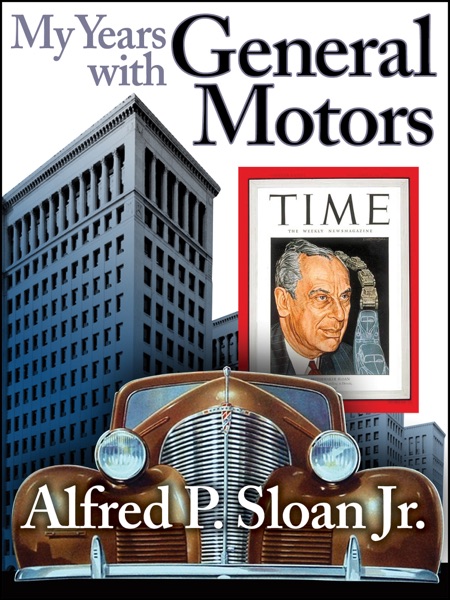
Talk to My Years with General Motors like its author wrote you back.
Get the ideas that fit your life — not generic summaries.
- Chat with the book
- Audiobook-style main ideas
- Adapts to your life and goals
- Helps you take action
My Years with General Motors, in detail
Alfred Sloan's account of his four decades building General Motors is one of the most influential management books ever written, though it reads less like a book and more like a carefully constructed argument. Sloan joined GM in 1918 when it was a loosely connected collection of car companies under the erratic control of William Durant. By the time he retired in 1956, he had built the largest industrial corporation in the world and had defeated Henry Ford's Model T with a radical different philosophy about how to sell cars and organize a company.
The central innovation Sloan describes is coordinated decentralization. Ford's genius was standardization and vertical integration; Sloan's was the opposite. He believed that autonomous divisions — Chevrolet, Pontiac, Buick, Oldsmobile, Cadillac — would outperform any centrally planned operation, provided that financial controls, policy, and strategic coordination sat at the corporate level. This structure became a template for the modern diversified corporation. Sloan gave division managers authority to run their businesses while holding them accountable through a rigorous system of financial reporting and return on investment targets. The details are dense, but the underlying logic is remarkably clear.
The marketing strategy is equally important. Ford offered one car in one color for the mass market. Sloan segmented the market by price point — "a car for every purse and purpose" — and introduced the annual model change to make last year's car feel inadequate. The strategy was shrewd and enormously profitable. It also introduced the logic of planned obsolescence to American consumer culture, a legacy Sloan discusses without apparent discomfort.
Reading it today, what strikes most is the intellectual seriousness Sloan brought to management problems that many contemporaries treated as intuition or personality. He wrote governance documents, established committees, designed reporting systems, and thought carefully about the problem of coordination at scale. The book has weaknesses: Sloan is a more comfortable strategist than he is a storyteller, and the chapters on finance and accounting will test general readers. But for anyone interested in how large organizations actually work, it remains a primary document.
The big ideas
- 1.
Coordinated decentralization — autonomous operating units with centralized financial controls and policy — was Sloan's core structural innovation and became the template for the modern corporation.
- 2.
Market segmentation by price point beat Ford's one-car strategy. Sloan built Chevrolet for the mass market and Cadillac for the wealthy, with Pontiac, Buick, and Oldsmobile in between.
- 3.
The annual model change was a deliberate strategy to stimulate demand and accelerate obsolescence. It generated enormous profits and shaped American consumer culture for generations.
