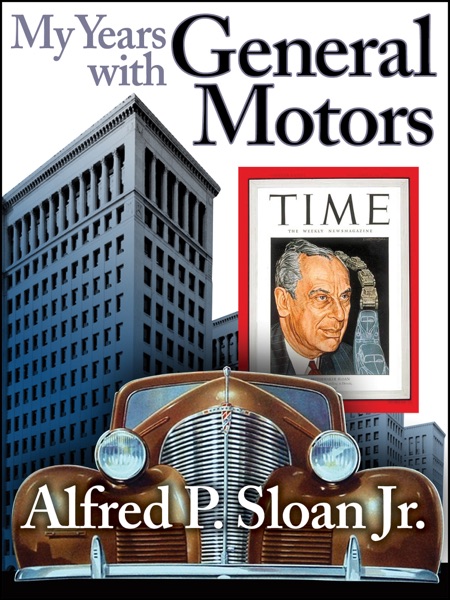
My Years with General Motors by Alfred P. Sloan is a 1964 business book about management, corporate strategy, organizational design. Coordinated decentralization — autonomous operating units with centralized financial controls and policy — was Sloan's core structural innovation and became the template for the modern corporation.
Summary
Alfred Sloan's account of his four decades building General Motors is one of the most influential management books ever written, though it reads less like a book and more like a carefully constructed argument. Sloan joined GM in 1918 when it was a loosely connected collection of car companies under the erratic control of William Durant. By the time he retired in 1956, he had built the largest industrial corporation in the world and had defeated Henry Ford's Model T with a radical different philosophy about how to sell cars and organize a company.
The central innovation Sloan describes is coordinated decentralization. Ford's genius was standardization and vertical integration; Sloan's was the opposite. He believed that autonomous divisions — Chevrolet, Pontiac, Buick, Oldsmobile, Cadillac — would outperform any centrally planned operation, provided that financial controls, policy, and strategic coordination sat at the corporate level. This structure became a template for the modern diversified corporation. Sloan gave division managers authority to run their businesses while holding them accountable through a rigorous system of financial reporting and return on investment targets. The details are dense, but the underlying logic is remarkably clear.
The marketing strategy is equally important. Ford offered one car in one color for the mass market. Sloan segmented the market by price point — "a car for every purse and purpose" — and introduced the annual model change to make last year's car feel inadequate. The strategy was shrewd and enormously profitable. It also introduced the logic of planned obsolescence to American consumer culture, a legacy Sloan discusses without apparent discomfort.
Reading it today, what strikes most is the intellectual seriousness Sloan brought to management problems that many contemporaries treated as intuition or personality. He wrote governance documents, established committees, designed reporting systems, and thought carefully about the problem of coordination at scale. The book has weaknesses: Sloan is a more comfortable strategist than he is a storyteller, and the chapters on finance and accounting will test general readers. But for anyone interested in how large organizations actually work, it remains a primary document.
Talk to My Years with General Motors like its author wrote you back.
Get the ideas that fit your life — not generic summaries.
- Chat with the book
- Audiobook-style main ideas
- Adapts to your life and goals
- Helps you take action
Key takeaways
- 1.
Coordinated decentralization — autonomous operating units with centralized financial controls and policy — was Sloan's core structural innovation and became the template for the modern corporation.
- 2.
Market segmentation by price point beat Ford's one-car strategy. Sloan built Chevrolet for the mass market and Cadillac for the wealthy, with Pontiac, Buick, and Oldsmobile in between.
- 3.
The annual model change was a deliberate strategy to stimulate demand and accelerate obsolescence. It generated enormous profits and shaped American consumer culture for generations.
- 4.
Return on investment, not revenue, was the primary metric Sloan used to allocate capital and evaluate division performance — a discipline that was unusual for its era.
- 5.
Management by policy: Sloan believed in writing things down. Governance documents, committee structures, and explicit decision rights made the organization legible and transferable.
- 6.
Finance as strategy: Sloan used the installment credit plan (through GMAC) to expand the addressable market beyond cash buyers, directly attacking Ford's advantage among working-class buyers.
- 7.
The executive committee and finance committee structure gave GM a functioning board capable of overseeing a multi-billion dollar enterprise without the CEO controlling every decision.
- 8.
Sloan's account of defeating Ford contains a clear lesson: a well-organized good-enough product beats a brilliant but inflexible one when the market diversifies.
Discussion questions
Use these on your own, with a book club, or as chat starters in Superbook. Book club version, ready to copy or print →
- 1.
Sloan argues that decentralization only works with strong central financial controls. Do you see this balance working or failing in organizations you know?
- 2.
The annual model change created planned obsolescence as a business strategy. How do you evaluate that legacy — clever competitive move or cultural harm?
- 3.
'A car for every purse and purpose' was a market segmentation insight. What market today is still treating all customers as if they have the same needs?
- 4.
Sloan managed through committees and written policy rather than personal authority. What are the advantages and costs of that approach compared to a founder-led culture?
- 5.
Ford won the early round with the Model T; Sloan won the next with flexibility and brand differentiation. What contemporary version of this dynamic do you see playing out?
- 6.
Sloan's financial discipline — measuring divisions by return on investment — is still unusual in many organizations. What does your organization actually measure, and what behavior does that produce?
- 7.
The book reveals very little about Sloan's personal life or emotional experience of the work. Does that absence tell you something about his character or just his genre?
- 8.
GM eventually became bloated and slow despite Sloan's systems. At what point do the same structures that enable scale begin to prevent adaptation?
- 9.
Sloan rarely mentions employees as stakeholders. How would the book read differently if the workforce's perspective were included?
- 10.
Which of Sloan's structural innovations — decentralization, financial metrics, committee governance, market segmentation — do you think holds up best in a modern context?
- 11.
Sloan built the largest corporation in the world and appears to have found it genuinely satisfying. What does that suggest about the relationship between organizational achievement and a meaningful life?
Themes
Frequently asked questions
-
Is My Years with General Motors worth reading?
Yes, for anyone serious about management, organizational design, or business history. It is dense in places and demands some patience, but the ideas about decentralization and financial discipline are foundational. Peter Drucker called it the best book on management he had ever read.
-
How long is My Years with General Motors?
About 500 pages in most editions. At an average reading pace expect 8 to 9 hours. The financial and accounting chapters in the middle are the densest; the strategic and competitive chapters are more accessible.
-
What is the central management idea in the book?
Coordinated decentralization: giving operating divisions genuine autonomy while maintaining central financial controls and strategic policy. Sloan believed this structure would outperform both pure centralization and pure decentralization.
-
Who should read this book?
Business historians, MBA students, executives interested in organizational design, and anyone trying to understand how large American corporations came to be structured the way they are. Less useful for founders or small-team managers — the lessons operate at significant scale.
-
Does it still apply to modern companies?
The structural ideas are still widely used and debated. The marketing innovations (segmentation, planned obsolescence) are so embedded in consumer culture they are invisible. The finance discipline remains relevant. The book shows its age in its treatment of labor and social responsibility.
Similar books
High Output Management
Andrew S. Grove
Good to Great
Jim Collins
The Effective Executive
Peter F. Drucker
Built to Last: Successful Habits of Visionary Companies
Jim Collins and Jerry I. Porras
