Talk to Neuromancer like its author wrote you back.
Get the ideas that fit your life — not generic summaries.
- Chat with the book
- Audiobook-style main ideas
- Adapts to your life and goals
- Helps you take action
What it argues
Case is a washed-up computer hacker living in the sprawl of near-future Chiba City, Japan. He was caught stealing from his employers, who damaged his nervous system as punishment, cutting him off from cyberspace — the matrix, the consensual hallucination of networked data where hackers can move and work. He spends the novel's opening pages in a suicidal holding pattern until a mysterious employer offers to fix him in exchange for a job. The job involves stealing something from an orbital corporation, and it involves Molly, a street samurai with mirrored lenses for eyes, and it is not at all what it appears to be.
Neuromancer invented the vocabulary of cyberspace — the word itself, the visual logic, the mythology of pure hackers moving through data as if it were physical space. Published in 1984, five years before the World Wide Web, it extrapolated from early network culture with such precision that it reads less like prediction than documentation of something that hadn't happened yet. Gibson's prose is dense, noir-inflected, and precise in its strangeness — images arrive with technical specificity that makes the invented world feel gritty and real.
What it gets right
- 1.
Gibson coined the term 'cyberspace' and defined the spatial metaphor of networked data that shaped how an entire generation visualized the internet before they'd ever used one.
- 2.
The novel's two AIs — Wintermute and Neuromancer — represent two halves of a whole: Wintermute is pure will with no sense of self, Neuromancer is pure identity with no capacity for action. Their merger is the novel's climax.
- 3.
Gibson's near-future is defined by corporate feudalism: nation-states have been superseded by zaibatsus, and power is wielded through private security and corporate law rather than governments.
What it covers
Who wrote it
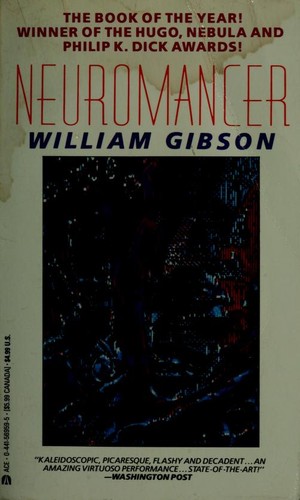
William Gibson is an American-Canadian author who coined the term "cyberspace" and helped found the cyberpunk movement with Neuromancer, which won the Hugo Award, the Nebula Award, and the Philip K. Dick Award — a sweep no other debut novel has matched. His subsequent novels include Count Zero, Mona Lisa Overdrive, Pattern Recognition, and The Peripheral. Gibson grew up in South Carolina, moved to Canada to avoid the Vietnam draft, and has lived in Vancouver since 1972. He is known for his precise, elliptical style and for his ability to extrapolate contemporary trends into plausible near-future worlds.
