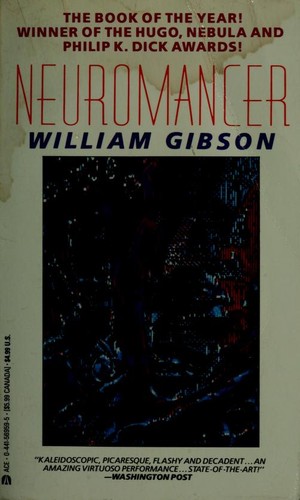
Neuromancer by William Gibson is a 1984 science fiction book about technology and identity, corporate power, artificial intelligence. Gibson coined the term 'cyberspace' and defined the spatial metaphor of networked data that shaped how an entire generation visualized the internet before they'd ever used one.
Summary
Case is a washed-up computer hacker living in the sprawl of near-future Chiba City, Japan. He was caught stealing from his employers, who damaged his nervous system as punishment, cutting him off from cyberspace — the matrix, the consensual hallucination of networked data where hackers can move and work. He spends the novel's opening pages in a suicidal holding pattern until a mysterious employer offers to fix him in exchange for a job. The job involves stealing something from an orbital corporation, and it involves Molly, a street samurai with mirrored lenses for eyes, and it is not at all what it appears to be.
Neuromancer invented the vocabulary of cyberspace — the word itself, the visual logic, the mythology of pure hackers moving through data as if it were physical space. Published in 1984, five years before the World Wide Web, it extrapolated from early network culture with such precision that it reads less like prediction than documentation of something that hadn't happened yet. Gibson's prose is dense, noir-inflected, and precise in its strangeness — images arrive with technical specificity that makes the invented world feel gritty and real.
The novel is not primarily about technology. It is about damaged people in a damaged world trying to make sense of large forces they can't fully understand. Case's arc is about loss — of his abilities, of a woman he loved, of his sense of self — and the question of whether you can want to live once you've lost what made living feel worth it. The high-concept plot about warring AI systems runs parallel to that more intimate story without fully resolving either.
Neuromancer is not an easy read on the first pass. Gibson drops the reader into the world with minimal orientation, trusts them to assemble the rules from the texture of the prose, and rewards re-reading. It is less a thriller than a fever dream with thriller bones. Those who click with its style find it electrifying; those who don't will find it willfully obscure. Its historical importance is beyond argument, and its influence — on cyberpunk, on depictions of the internet, on science fiction's relationship to contemporary technology — is enormous.
Talk to Neuromancer like its author wrote you back.
Get the ideas that fit your life — not generic summaries.
- Chat with the book
- Audiobook-style main ideas
- Adapts to your life and goals
- Helps you take action
Key takeaways
- 1.
Gibson coined the term 'cyberspace' and defined the spatial metaphor of networked data that shaped how an entire generation visualized the internet before they'd ever used one.
- 2.
The novel's two AIs — Wintermute and Neuromancer — represent two halves of a whole: Wintermute is pure will with no sense of self, Neuromancer is pure identity with no capacity for action. Their merger is the novel's climax.
- 3.
Gibson's near-future is defined by corporate feudalism: nation-states have been superseded by zaibatsus, and power is wielded through private security and corporate law rather than governments.
- 4.
Case's addiction to cyberspace is presented with the same weight as his drug addiction — the line between the two is deliberately blurred, and the novel's world treats both as equivalent dependencies.
- 5.
Molly's character — a razor-equipped, economically independent mercenary who has survived systemic violence with her agency intact — was genuinely unusual in 1984 action science fiction.
- 6.
The 'meat' — the body — is treated with contempt by hackers in the novel's world: the purest form of consciousness is disembodied data. Gibson presents this as a pathology, not an ideal.
- 7.
The Tessier-Ashpool family, the orbital corporation at the novel's center, represents the terminal stage of dynastic capitalism: inherited wealth that has become so isolated from consequence that it has gone mad.
- 8.
Neuromancer established the template for cyberpunk's visual language — neon and decay, hi-tech and lowlife, prosthetic bodies and corporate logos — which has been borrowed so extensively it now feels like a natural aesthetic.
Discussion questions
Use these on your own, with a book club, or as chat starters in Superbook. Book club version, ready to copy or print →
- 1.
Gibson drops the reader into the world without explanation. Did that narrative choice work for you, or did you find the first fifty pages alienating?
- 2.
Case thinks of his body as 'the meat' — an obstacle to the real life of cyberspace. Is the novel endorsing that view, critiquing it, or both?
- 3.
Molly is arguably the most capable character in the novel, but we experience the story through Case. What do we lose by not having her perspective?
- 4.
The two AIs want to merge into a single entity. Is that presented as a good outcome, a neutral one, or something the novel leaves genuinely ambiguous?
- 5.
Gibson wrote Neuromancer before the internet existed in any public form. Which parts of his prediction feel most accurate, and which feel most wrong?
- 6.
The zaibatsus have replaced nation-states as the primary power structures in the novel. How much does that feel like a plausible extrapolation of corporate power in 2026?
- 7.
The Dixie Flatline — a dead hacker's personality stored as a ROM construct — raises questions about consciousness and identity. Does the novel take those questions seriously, or are they set-dressing?
- 8.
Neuromancer has been enormously influential. Does reading it now, knowing how much it shaped subsequent work, change how you evaluate it as a novel?
- 9.
Case is passive for much of the novel — he is being managed by forces larger than himself without knowing it. Is that passivity a feature or a flaw?
- 10.
Compared to Philip K. Dick's explorations of artificial identity and corporate power — is Gibson more pessimistic, more optimistic, or just different?
- 11.
The prose style is dense and deliberately difficult. Is that difficulty earned, or is it obscurantism dressed as complexity?
- 12.
The novel ends with Case returned to the meat world and Neuromancer gone. Is that a hopeful ending or a melancholy one?
Themes
Frequently asked questions
-
Is Neuromancer hard to read?
Yes, initially. Gibson provides very little onboarding — you're dropped into a world with its own slang, geography, and technology and expected to infer the rules. Most readers find the first fifty pages the hardest, after which the logic of the world becomes legible. Re-reading the opening chapters after finishing the novel is almost mandatory.
-
Do I need to read the full Sprawl trilogy?
Neuromancer stands alone well. Count Zero and Mona Lisa Overdrive continue in the same world but with different protagonists. Most readers read all three, but they're not necessary for Neuromancer to make sense.
-
Is Neuromancer dated?
The aesthetic is very 1980s, and some of the technology has been lapped by reality in odd ways. But the novel's concerns — corporate power, identity in networked space, what it means to be embodied — remain current. It reads less as a prediction than as a mythologization of anxieties that haven't gone away.
-
Is there a film adaptation?
As of 2026, no film adaptation has been successfully made, despite decades of attempts. The novel's dense, interior style has made it notoriously difficult to adapt. Johnny Mnemonic (1995) and New Rose Hotel (1998) adapted related Gibson work, with mixed results.
-
Who shouldn't read Neuromancer?
Readers who need clear plot mechanics, sympathetic protagonists, and emotionally warm prose will struggle. The style is cool, the world is hostile, and the plot requires work to follow. It is also a product of its moment — some of the gender dynamics and racial coding feel dated.