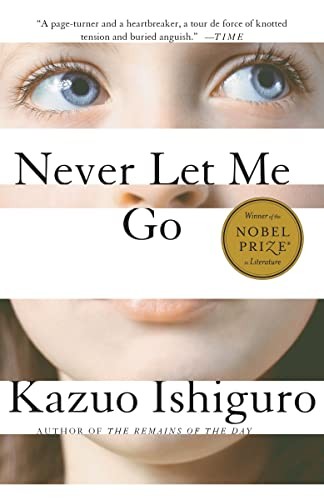
Talk to Never Let Me Go like its author wrote you back.
Get the ideas that fit your life — not generic summaries.
- Chat with the book
- Audiobook-style main ideas
- Adapts to your life and goals
- Helps you take action
Never Let Me Go, in detail
Kathy H. is a carer in her early thirties, looking back on her childhood at Hailsham, an English boarding school, and on her relationships with her two closest friends, Ruth and Tommy. The novel is structured as Kathy's reminiscence, and Ishiguro parcels out its central revelation slowly: the children at Hailsham are clones, raised to donate their organs in adulthood. By the time you understand this fully, you're too far inside Kathy's voice to experience it as science fiction.
Ishiguro is not interested in the mechanics of the dystopia or the injustice of the clones' condition. He is interested in how people accommodate their own mortality — how Kathy and her friends know, at some level, what they are and what awaits them, and arrange their emotional lives around that knowledge without ever quite confronting it directly. The children speculate about "deferrals" for couples in love; they seek meaning in their artwork; they navigate the same petty jealousies and loyalties as any children. The horror of the novel is not that the system exists but that everyone in it has found a way to live with it.
The prose is Kathy's voice, and it's Ishiguro's most precise formal achievement: conversational, digressive, full of qualifications and loops back, but never slow. The digressiveness enacts Kathy's psychology — she approaches the painful material from oblique angles, circles back, says "I don't know" at moments when she clearly does know. Reading it, you're aware that something is being withheld, but the withholding feels like a personality rather than a trick.
This is a deeply sad book, and it is not interested in consolation. Readers who want science fiction world-building won't find it; readers who want resolution or hope should not expect it. What they will find is one of the most precise accounts in recent fiction of what it means to face an ending you cannot change — and to have loved people, and to have been loved imperfectly, along the way.
The big ideas
- 1.
The dystopia is withheld and revealed gradually, but the novel is not a thriller — once you understand the situation, it asks you to sit with it rather than resist it.
- 2.
Kathy's narration is calibrated to approach the most painful material obliquely — the gaps and deflections are the emotional content, not its absence.
- 3.
The children's passive acceptance of their fate is the novel's most disturbing element. Ishiguro suggests this passivity is not stupidity but a specifically human form of accommodation.
