Talk to Night like its author wrote you back.
Get the ideas that fit your life — not generic summaries.
- Chat with the book
- Audiobook-style main ideas
- Adapts to your life and goals
- Helps you take action
What it argues
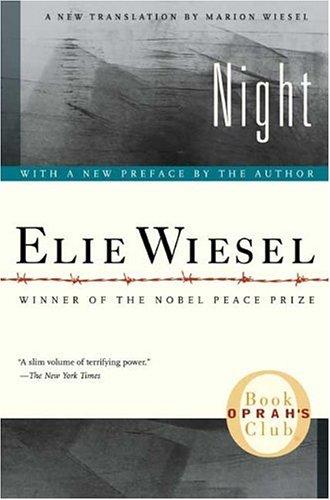
Night is Elie Wiesel's account of his deportation from the Transylvanian town of Sighet in 1944 and his survival of Auschwitz and Buchenwald concentration camps. Originally written in Yiddish and published in French in 1958, it did not reach a wide English-language audience until a 1960 American translation. It is now one of the most widely read books in the world — assigned in schools across dozens of countries, translated into thirty languages, and cited by Wiesel himself as a witness-testimony rather than a novel or a literary work.
The narrative begins with Wiesel's adolescence in Sighet, where he was absorbed in the study of Jewish mysticism. The town's Jewish community received warnings of deportation but largely could not bring themselves to believe the worst. By 1944 the family was on a cattle car to Auschwitz, and the memoir's tone shifts permanently at the moment of arrival and the first encounter with the selection process. Wiesel's mother and younger sister Tzipora were directed to the left; he and his father were directed to the right. He never saw them again.
What it gets right
- 1.
Witnessing imposes an obligation. Wiesel spent years in silence before writing Night, and the book is partly about the responsibility to speak even when speech falls short.
- 2.
Dehumanization happens in stages. The process that ended at the crematoria began with yellow stars, curfews, and property seizures that each seemed survivable in isolation.
- 3.
Faith is tested by atrocity, not simply extinguished. Wiesel's religious crisis is an argument with God, not an abandonment — which makes it more searching than either devout acceptance or atheism.
What it covers
Who wrote it
Elie Wiesel (1928–2016) was a Romanian-born Jewish writer, professor, and political activist who survived Auschwitz and Buchenwald. After the war he worked as a journalist in France before publishing his testimony in Yiddish as Un di velt hot geshvign (And the World Remained Silent) in 1956. The condensed French version, La Nuit, appeared in 1958. Wiesel taught at Boston University for decades, received the Nobel Peace Prize in 1986, and wrote more than fifty books on Jewish history, theology, and ethics. He is widely considered the most important literary witness to the Holocaust.
