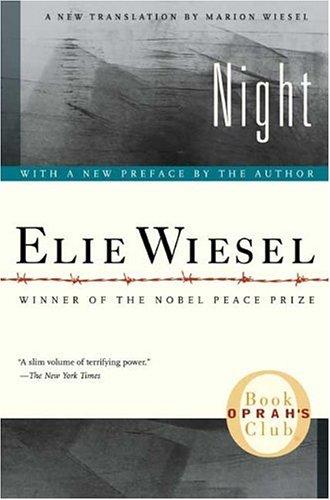
Talk to Night like its author wrote you back.
Get the ideas that fit your life — not generic summaries.
- Chat with the book
- Audiobook-style main ideas
- Adapts to your life and goals
- Helps you take action
Night, in detail
Night is Elie Wiesel's account of his deportation from the Transylvanian town of Sighet in 1944 and his survival of Auschwitz and Buchenwald concentration camps. Originally written in Yiddish and published in French in 1958, it did not reach a wide English-language audience until a 1960 American translation. It is now one of the most widely read books in the world — assigned in schools across dozens of countries, translated into thirty languages, and cited by Wiesel himself as a witness-testimony rather than a novel or a literary work.
The narrative begins with Wiesel's adolescence in Sighet, where he was absorbed in the study of Jewish mysticism. The town's Jewish community received warnings of deportation but largely could not bring themselves to believe the worst. By 1944 the family was on a cattle car to Auschwitz, and the memoir's tone shifts permanently at the moment of arrival and the first encounter with the selection process. Wiesel's mother and younger sister Tzipora were directed to the left; he and his father were directed to the right. He never saw them again.
The book's moral center is the relationship between Eliezer and his father Shlomo. In the camps, where each prisoner is incentivized to think only of their own survival, Wiesel describes the terrible cost and moral significance of maintaining a bond. He also traces what the experience did to his faith — not a clean loss of belief but a prolonged, agonized argument with God. The hanging of a child in Auschwitz, an incident that generates the book's most famous passage, crystallizes this rupture.
Night is short — fewer than 120 pages in most editions — and the compression is deliberate. Wiesel revised the original Yiddish manuscript heavily, stripping it to its essential testimony. The brevity adds to its impact rather than diminishing it. By the final pages, when the surviving prisoners are liberated and Wiesel looks into a mirror for the first time since deportation and sees a corpse looking back, the reader understands why the book required a decade of silence before Wiesel could write it.
The big ideas
- 1.
Witnessing imposes an obligation. Wiesel spent years in silence before writing Night, and the book is partly about the responsibility to speak even when speech falls short.
- 2.
Dehumanization happens in stages. The process that ended at the crematoria began with yellow stars, curfews, and property seizures that each seemed survivable in isolation.
- 3.
Faith is tested by atrocity, not simply extinguished. Wiesel's religious crisis is an argument with God, not an abandonment — which makes it more searching than either devout acceptance or atheism.
