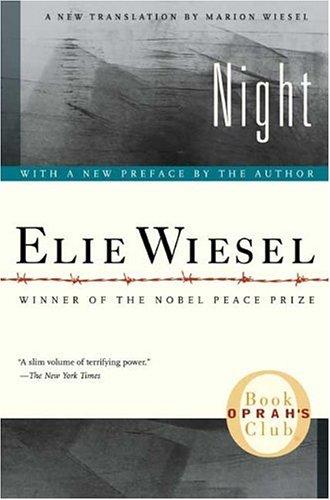
Night by Elie Wiesel is a 1960 memoir book about survival, faith, dehumanization. Witnessing imposes an obligation. Wiesel spent years in silence before writing Night, and the book is partly about the responsibility to speak even when speech falls short.
Summary
Night is Elie Wiesel's account of his deportation from the Transylvanian town of Sighet in 1944 and his survival of Auschwitz and Buchenwald concentration camps. Originally written in Yiddish and published in French in 1958, it did not reach a wide English-language audience until a 1960 American translation. It is now one of the most widely read books in the world — assigned in schools across dozens of countries, translated into thirty languages, and cited by Wiesel himself as a witness-testimony rather than a novel or a literary work.
The narrative begins with Wiesel's adolescence in Sighet, where he was absorbed in the study of Jewish mysticism. The town's Jewish community received warnings of deportation but largely could not bring themselves to believe the worst. By 1944 the family was on a cattle car to Auschwitz, and the memoir's tone shifts permanently at the moment of arrival and the first encounter with the selection process. Wiesel's mother and younger sister Tzipora were directed to the left; he and his father were directed to the right. He never saw them again.
The book's moral center is the relationship between Eliezer and his father Shlomo. In the camps, where each prisoner is incentivized to think only of their own survival, Wiesel describes the terrible cost and moral significance of maintaining a bond. He also traces what the experience did to his faith — not a clean loss of belief but a prolonged, agonized argument with God. The hanging of a child in Auschwitz, an incident that generates the book's most famous passage, crystallizes this rupture.
Night is short — fewer than 120 pages in most editions — and the compression is deliberate. Wiesel revised the original Yiddish manuscript heavily, stripping it to its essential testimony. The brevity adds to its impact rather than diminishing it. By the final pages, when the surviving prisoners are liberated and Wiesel looks into a mirror for the first time since deportation and sees a corpse looking back, the reader understands why the book required a decade of silence before Wiesel could write it.
Talk to Night like its author wrote you back.
Get the ideas that fit your life — not generic summaries.
- Chat with the book
- Audiobook-style main ideas
- Adapts to your life and goals
- Helps you take action
Key takeaways
- 1.
Witnessing imposes an obligation. Wiesel spent years in silence before writing Night, and the book is partly about the responsibility to speak even when speech falls short.
- 2.
Dehumanization happens in stages. The process that ended at the crematoria began with yellow stars, curfews, and property seizures that each seemed survivable in isolation.
- 3.
Faith is tested by atrocity, not simply extinguished. Wiesel's religious crisis is an argument with God, not an abandonment — which makes it more searching than either devout acceptance or atheism.
- 4.
The father-son bond under extreme duress reveals something about the limits and possibilities of love. Wiesel maintains the bond at great personal cost and still feels he failed.
- 5.
Survival requires moral compromises that the survivor must then live with. Night does not resolve these compromises but insists they be named.
- 6.
Bystanders and perpetrators exist on a continuum. The townspeople of Sighet who refused to believe, the kapos who collaborated, and the SS who gave orders are all part of the same system.
- 7.
Memory as ethical practice: for Wiesel, forgetting is a second death. The memoir exists to prevent the erasure of the murdered.
- 8.
The book's brevity is a formal argument. Wiesel's compression suggests that some experiences exceed language, and that the attempt to render them fully might itself be obscene.
Discussion questions
Use these on your own, with a book club, or as chat starters in Superbook. Book club version, ready to copy or print →
- 1.
Wiesel takes years to write Night, deciding finally that silence is itself a form of complicity. Where is the line between necessary silence and ethical obligation to speak?
- 2.
The townspeople of Sighet received warnings and did not act on them. What psychological mechanisms allow people to disbelieve information that contradicts their assumptions about safety?
- 3.
How does Wiesel describe the transformation in his father's role during the camp experience? What does it mean when the roles of parent and child effectively reverse?
- 4.
The hanging of the child in Auschwitz prompts a prisoner to ask 'Where is God?' and Wiesel hears a voice answer 'Here He is — He is hanging here on this gallows.' How do you interpret that passage?
- 5.
Wiesel admits to thoughts and impulses in the camps that he finds shameful in retrospect. How does that honesty affect your reading of him as a narrator?
- 6.
Night is short partly because Wiesel believed the original Yiddish manuscript was too long — too much detail could become spectacle. Do you think the compression is the right choice?
- 7.
What distinguishes Night from other Holocaust memoirs you have read or know about? What does this particular account do that others do not?
- 8.
Wiesel survived and his father did not. How does survivor's guilt operate in the text, and does Wiesel ever seem to find a way through it?
- 9.
The book ends with Wiesel seeing a corpse in the mirror. What does that image mean, and why is it the last image of the book?
- 10.
Night is often the first Holocaust text young people read. Is there an argument for or against introducing this material through memoir rather than history?
- 11.
Wiesel became a prominent public intellectual and activist after writing Night. Does the public career change how you think about the private testimony?
- 12.
The memoir raises the question of whether bearing witness is enough, or whether witness must be paired with some form of action. What does Wiesel himself seem to believe?
Themes
Frequently asked questions
-
Is Night a memoir or a novel?
It is a memoir — Wiesel's first-person account of his own experience. The protagonist shares his first name, Eliezer, and the events are autobiographical. Wiesel was careful to distinguish it from fiction, and it is classified and taught as testimony.
-
How long does it take to read Night?
About two hours. The book is under 120 pages in most editions. Its brevity is intentional — Wiesel condensed a much longer Yiddish manuscript into this concentrated account. The shortness does not make it easier to read.
-
Why did Wiesel wait so long to publish Night?
He observed a self-imposed ten-year silence after liberation, believing that adequate language for what happened did not yet exist and that hasty testimony risked trivializing the experience. He began writing only after meeting the French Catholic writer François Mauriac, who convinced him to speak.
-
What is the significance of the title Night?
It operates on multiple levels: the literal darkness of the camps, the spiritual darkness of abandoned faith, the psychological night of dehumanization, and the broader historical darkness of the Holocaust. Wiesel has said the title refers to the night that never ended.
-
How does Night differ from Wiesel's other books?
Night is the foundational testimony; his subsequent books — Dawn, Day — engage with life after the Holocaust. Night is the most direct and autobiographical. His later works are more philosophical and occasionally novelistic, but Night remains the work he is identified with and the one that carries the weight of witness.