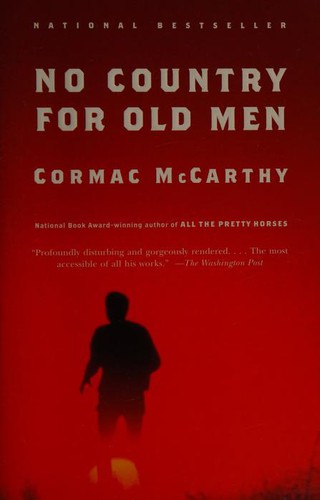
Talk to No Country for Old Men like its author wrote you back.
Get the ideas that fit your life — not generic summaries.
- Chat with the book
- Audiobook-style main ideas
- Adapts to your life and goals
- Helps you take action
No Country for Old Men, in detail
No Country for Old Men begins in the Texas desert in 1980 where a Vietnam veteran named Llewelyn Moss stumbles on the aftermath of a drug deal gone wrong: a ring of dead men, trucks, a cache of heroin, and two million dollars in a case. He takes the money. That decision sets three trajectories in motion — Moss's flight, the pursuit of the hitman Anton Chigurh, and the parallel monologues of aging Sheriff Ed Tom Bell, who watches the violence unfold with growing certainty that the world has become something he can no longer account for.
The novel operates as a meditation on entropy dressed as a thriller. Chigurh is its formal center — a man who has reduced ethics to a coin flip and who pursues Moss with relentless, almost bureaucratic calm. McCarthy is careful not to explain him. He doesn't have a psychology to untangle; he is something closer to a principle, a demonstration of what happens when violence detaches entirely from feeling. Bell, meanwhile, is the novel's moral voice — and McCarthy gives him a voice that registers defeat rather than resistance. Bell keeps retiring inward, remembering his father, wondering what kind of world leaves a man his age with nothing useful left to do.
McCarthy originally wrote this as a screenplay before expanding it into a novel, and the stripped-down style shows — the book is predominantly scene and dialogue, the prose leaner than Blood Meridian and more immediately accessible. The Coen Brothers' 2007 adaptation is one of the most faithful novel-to-film translations in American cinema; reading the book after seeing the film is a different but still worthwhile experience. The novel adds Bell's interior monologues, which the film's famous ending carries in visual form but the book renders explicitly.
Readers who want plot closure will be frustrated: the novel's climax is deliberately withheld. This is not an oversight. McCarthy is arguing that the kind of story where the good man beats the bad man and the money gets recovered is the kind of story that is no longer available — if it ever was. Those who accept that framing will find No Country for Old Men to be one of the most precise and unsettling American novels of the past twenty years.
The big ideas
- 1.
Chigurh functions not as a villain in the traditional sense but as a philosophical position made flesh — the idea that violence is impersonal, arbitrary, and amoral.
- 2.
Bell's monologues carry the novel's emotional weight. He is a man watching the world become unrecognizable and having no framework that helps him understand why.
- 3.
McCarthy refuses the conventional thriller ending. The hero doesn't win. The money doesn't matter. What matters is Bell's dream in the final pages.
