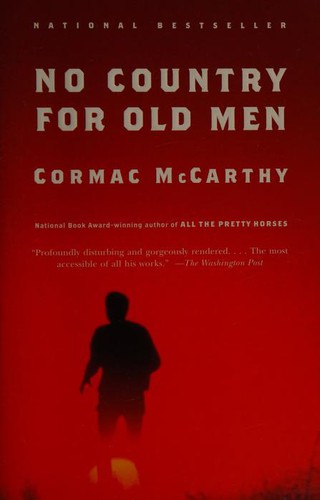
No Country for Old Men by Cormac McCarthy is a 2005 literary fiction book about violence and modernity, fate and chance, moral decline. Chigurh functions not as a villain in the traditional sense but as a philosophical position made flesh — the idea that violence is impersonal, arbitrary, and amoral.
Summary
No Country for Old Men begins in the Texas desert in 1980 where a Vietnam veteran named Llewelyn Moss stumbles on the aftermath of a drug deal gone wrong: a ring of dead men, trucks, a cache of heroin, and two million dollars in a case. He takes the money. That decision sets three trajectories in motion — Moss's flight, the pursuit of the hitman Anton Chigurh, and the parallel monologues of aging Sheriff Ed Tom Bell, who watches the violence unfold with growing certainty that the world has become something he can no longer account for.
The novel operates as a meditation on entropy dressed as a thriller. Chigurh is its formal center — a man who has reduced ethics to a coin flip and who pursues Moss with relentless, almost bureaucratic calm. McCarthy is careful not to explain him. He doesn't have a psychology to untangle; he is something closer to a principle, a demonstration of what happens when violence detaches entirely from feeling. Bell, meanwhile, is the novel's moral voice — and McCarthy gives him a voice that registers defeat rather than resistance. Bell keeps retiring inward, remembering his father, wondering what kind of world leaves a man his age with nothing useful left to do.
McCarthy originally wrote this as a screenplay before expanding it into a novel, and the stripped-down style shows — the book is predominantly scene and dialogue, the prose leaner than Blood Meridian and more immediately accessible. The Coen Brothers' 2007 adaptation is one of the most faithful novel-to-film translations in American cinema; reading the book after seeing the film is a different but still worthwhile experience. The novel adds Bell's interior monologues, which the film's famous ending carries in visual form but the book renders explicitly.
Readers who want plot closure will be frustrated: the novel's climax is deliberately withheld. This is not an oversight. McCarthy is arguing that the kind of story where the good man beats the bad man and the money gets recovered is the kind of story that is no longer available — if it ever was. Those who accept that framing will find No Country for Old Men to be one of the most precise and unsettling American novels of the past twenty years.
Talk to No Country for Old Men like its author wrote you back.
Get the ideas that fit your life — not generic summaries.
- Chat with the book
- Audiobook-style main ideas
- Adapts to your life and goals
- Helps you take action
Key takeaways
- 1.
Chigurh functions not as a villain in the traditional sense but as a philosophical position made flesh — the idea that violence is impersonal, arbitrary, and amoral.
- 2.
Bell's monologues carry the novel's emotional weight. He is a man watching the world become unrecognizable and having no framework that helps him understand why.
- 3.
McCarthy refuses the conventional thriller ending. The hero doesn't win. The money doesn't matter. What matters is Bell's dream in the final pages.
- 4.
The novel stages a debate between fatalism and agency — Chigurh argues the coin decides, but the novel's events suggest humans make choices that have genuine consequences.
- 5.
The 1980 Texas border setting is specific and deliberate — a place where the drug economy was reshaping violence in ways law enforcement was structurally unequipped to handle.
- 6.
McCarthy's prose in this novel is more pared-down than elsewhere — closer to Hemingway than to the biblical cadences of Blood Meridian.
- 7.
Bell's final dream — riding behind his father, unable to catch up — is one of McCarthy's most discussed images, and the most direct statement of the novel's mood.
- 8.
The Coen Brothers adaptation follows the novel so closely it functions almost as a director's commentary on McCarthy's choices.
Discussion questions
Use these on your own, with a book club, or as chat starters in Superbook. Book club version, ready to copy or print →
- 1.
Chigurh tells Carla Jean the coin decides. She tells him he makes his own choices. Who does the novel think is right?
- 2.
Bell retires rather than continuing to fight. Is that a failure or an honest acknowledgment of limits? Does the novel judge him for it?
- 3.
Moss makes a fatal error when he goes back to help a dying man in the desert. Is that an act of humanity or hubris? How does the novel frame it?
- 4.
The novel's climax — Moss's death — happens off-page. Why? What does McCarthy gain or lose by that choice?
- 5.
Bell's monologues interrupt the action-thriller plot. How do they change the reading experience? What would the book be without them?
- 6.
Chigurh survives a car accident and walks away. Is that a supernatural suggestion, or is McCarthy doing something else?
- 7.
The title comes from Yeats — 'That is no country for old men.' How does the poem's context (a man looking at youth, sailing toward Byzantium) deepen or complicate the novel?
- 8.
McCarthy wrote this as a screenplay first. Where do you feel the screenplay origins most — in the scene structure, the dialogue, elsewhere?
- 9.
The film is considered one of the best adaptations ever made. Having read the novel, what do you think the film captures and what does it lose?
- 10.
Bell keeps invoking his father and grandfather — men who served and were, he implies, better suited to their time. Is the novel nostalgic for something, or is it interrogating nostalgia?
- 11.
Carla Jean is one of the novel's most clear-eyed characters. What is McCarthy doing with her in the final confrontation with Chigurh?
- 12.
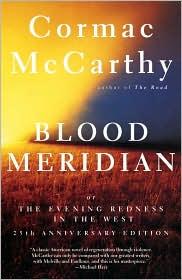
No Country is sometimes read alongside Blood Meridian as companion texts on American violence. Are they making the same argument?
Themes
Frequently asked questions
-
Should I read the book or watch the movie first?
Either works, but reading the book first gives you Bell's interior monologues unmediated — the film translates them visually with great skill but the prose versions are richer. The film is so faithful that reading after watching is mostly an exercise in comparing choices rather than discovering new story.
-
Why doesn't the book have a proper ending?
McCarthy's refusal to show Moss's death and the withholding of a conventional thriller resolution is the point. Bell's final dream is the ending — a man riding into darkness, following a light he cannot catch. The novel is about the collapse of the story where the lawman wins. Giving that story its expected ending would undercut the argument.
-
Is No Country for Old Men as violent as Blood Meridian?
No. The violence here is stark and precise but far less sustained. No Country is more accessible — shorter, cleaner prose, a more recognizable genre structure that McCarthy then refuses to fulfill in the expected way.
-
Who is Chigurh based on?
No direct real-world model is known. McCarthy has described him as a representation of a certain kind of completely amoral, self-referential violence — a type rather than a person. His coin-flip ethics are an original construct, not derived from a specific criminal.
-
Who shouldn't read this book?
Readers who need narrative closure or who find existential futility in fiction more nihilistic than honest. The novel ends on defeat — Bell's dream is bleak, and no one is saved. If that framing feels like a cheat rather than a philosophical position, the book won't work for you.