Economics · Book club
Nudge: Improving Decisions About Health, Wealth, and Happiness book club questions
Here are 12 book club questions for Nudge: Improving Decisions About Health, Wealth, and Happiness by Richard H. Thaler and Cass R. Sunstein, ordered to open easily and end somewhere worth arguing about. Copy them, print them, or bring them up one at a time.
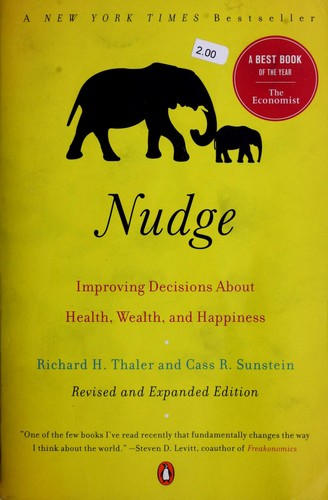
Nudge is Richard Thaler and Cass Sunstein's argument that the way choices are presented — the default option, the order of items, the framing of a question — powerfully shapes what people decide, often more than their own stated preferences.
Richard H. Thaler and Cass R. Sunstein · 2008 · 6h 0m
Full summary and key takeaways →The 12 questions
- 1.
Thaler and Sunstein say there is no such thing as a neutral choice architecture. Do you agree? Can you think of a counterexample from your own life?
- 2.
The book distinguishes nudges from mandates. Where would you personally draw the line between acceptable influence and unacceptable manipulation?
- 3.
Which default in your own life — financial, medical, digital — has shaped a major decision without your realizing it at the time?
- 4.
The opt-out retirement enrollment example is the book's most celebrated finding. Why do you think making saving the default was politically easier than mandating it?
- 5.
Thaler and Sunstein argue that humans predictably deviate from rational choice. Does knowing this change how you think about your own decision-making?
- 6.
The authors are unapologetic about the paternalist element of their framework. What makes a nudge legitimate, and what would make one manipulative or coercive?
- 7.
Social norm messaging — 'most of your neighbors recycle' — works. Does knowing the mechanism make you more or less susceptible to it?
- 8.
Pick a domain where you've observed bad choice architecture: a form, a product, a government process. What would a well-designed version look like?
- 9.
The book was written partly as a policy argument. Have you seen nudge theory applied in the real world? Did the outcome match the theory?
- 10.
Sunstein has argued that 'sludge' — unnecessary friction — is as important to remove as nudges are to add. Where do you encounter the most sludge in your daily life?
- 11.
The authors apply their framework to organ donation, school choice, healthcare, and retirement. Which application do you find most persuasive, and which do you find most troubling?
- 12.
Nudge theory assumes that behavioral economists know what outcomes are in people's best interests. Is that assumption safe? Who gets to decide?
How to run the discussion
- Pick six to eight, not all of them. An hour of real discussion covers fewer questions than anyone expects, and racing the list is what makes a book club feel like homework.
- Open with what people noticed, not what they concluded. Asking for a verdict first hardens opinions before anyone has heard each other.
- Let the disagreement run. The questions below that split a room are the ones worth the time; the ones everyone answers the same way can be skipped.
- Ask the quiet person a specific question. A direct, narrow question is far easier to answer than an open invitation to contribute.
Themes worth steering toward
If the conversation stalls, these are the threads that usually restart it.
Common questions
What are good book club questions for Nudge: Improving Decisions About Health, Wealth, and Happiness?
Here are 12 book club questions for Nudge: Improving Decisions About Health, Wealth, and Happiness by Richard H. Thaler and Cass R. Sunstein, ordered to open easily and end somewhere worth arguing about. The strongest openers ask what each reader noticed rather than what they concluded, and the discussion usually turns on choice architecture, behavioral economics, decision-making.
How long should a book club discussion of Nudge: Improving Decisions About Health, Wealth, and Happiness last?
Most groups run 60 to 90 minutes of actual discussion. That is roughly six to eight questions, not all of them, so pick the ones that suit your group rather than working down the list in order.
What are the main themes in Nudge: Improving Decisions About Health, Wealth, and Happiness?
Choice architecture, Behavioral economics, Decision-making, Public policy, Libertarian paternalism. Those are the threads most likely to divide a room, which makes them the useful places to steer a discussion that has gone quiet.
Picking the next one? See books like Nudge: Improving Decisions About Health, Wealth, and Happiness or questions for other book club picks.
