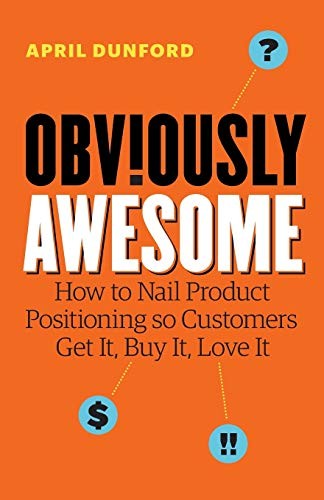
Talk to Obviously Awesome like its author wrote you back.
Get the ideas that fit your life — not generic summaries.
- Chat with the book
- Audiobook-style main ideas
- Adapts to your life and goals
- Helps you take action
Obviously Awesome, in detail
Obviously Awesome is April Dunford's practical guide to product positioning — the often misunderstood discipline of defining where your product fits in the competitive landscape so that the right customers immediately understand its value. Dunford spent twenty years as a marketing executive at enterprise software companies and repositioned their products multiple times. The book is a crystallization of what she learned: most tech companies ship positioning by default rather than by design, and default positioning is almost always wrong.
Dunford defines positioning as the context in which customers understand your product. Position a product in the wrong context and its value becomes invisible — not because the product is bad, but because customers can't see it clearly. Her diagnosis is that founders and product teams confuse positioning with messaging, taglines, and value propositions. These are outputs of good positioning, not positioning itself. Positioning is the upstream decision that makes everything else downstream — messaging, sales plays, pricing, and even product roadmap — clearer.
The five components of positioning are: competitive alternatives (what customers would do if your product didn't exist), unique attributes (what you have that those alternatives don't), value (what those attributes enable for customers), customer segments (who cares most about that value), and market frame of reference (the context that makes the value obvious). Dunford is explicit that the market frame of reference is the most powerful and most misused lever: many companies position themselves as "X for Y" when they'd be better served by creating a new subcategory or repositioning within an adjacent but better-fitting market.
The book is short, direct, and structured as a step-by-step process. Dunford uses real examples from companies she worked with, and the positioning canvas she provides is immediately usable. The limitation is scope: Obviously Awesome focuses tightly on the process of finding positioning, not on implementing or defending it at scale. For execution, readers will need to look elsewhere.
The big ideas
- 1.
Positioning is the context you set for customers to understand your product's value. Wrong context makes your product invisible no matter how good it is.
- 2.
Most companies ship positioning by default — they position products as the thing they most resemble rather than the thing that best captures their unique value.
- 3.
The five components of positioning: competitive alternatives, unique attributes, value, target customer segments, and market frame of reference.
