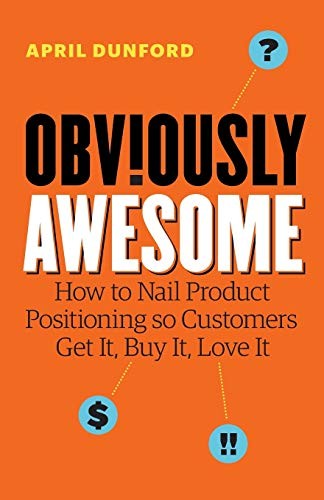
Obviously Awesome by April Dunford is a 2019 business book about marketing, product positioning, startups. Positioning is the context you set for customers to understand your product's value. Wrong context makes your product invisible no matter how good it is.
Summary
Obviously Awesome is April Dunford's practical guide to product positioning — the often misunderstood discipline of defining where your product fits in the competitive landscape so that the right customers immediately understand its value. Dunford spent twenty years as a marketing executive at enterprise software companies and repositioned their products multiple times. The book is a crystallization of what she learned: most tech companies ship positioning by default rather than by design, and default positioning is almost always wrong.
Dunford defines positioning as the context in which customers understand your product. Position a product in the wrong context and its value becomes invisible — not because the product is bad, but because customers can't see it clearly. Her diagnosis is that founders and product teams confuse positioning with messaging, taglines, and value propositions. These are outputs of good positioning, not positioning itself. Positioning is the upstream decision that makes everything else downstream — messaging, sales plays, pricing, and even product roadmap — clearer.
The five components of positioning are: competitive alternatives (what customers would do if your product didn't exist), unique attributes (what you have that those alternatives don't), value (what those attributes enable for customers), customer segments (who cares most about that value), and market frame of reference (the context that makes the value obvious). Dunford is explicit that the market frame of reference is the most powerful and most misused lever: many companies position themselves as "X for Y" when they'd be better served by creating a new subcategory or repositioning within an adjacent but better-fitting market.
The book is short, direct, and structured as a step-by-step process. Dunford uses real examples from companies she worked with, and the positioning canvas she provides is immediately usable. The limitation is scope: Obviously Awesome focuses tightly on the process of finding positioning, not on implementing or defending it at scale. For execution, readers will need to look elsewhere.
Talk to Obviously Awesome like its author wrote you back.
Get the ideas that fit your life — not generic summaries.
- Chat with the book
- Audiobook-style main ideas
- Adapts to your life and goals
- Helps you take action
Key takeaways
- 1.
Positioning is the context you set for customers to understand your product's value. Wrong context makes your product invisible no matter how good it is.
- 2.
Most companies ship positioning by default — they position products as the thing they most resemble rather than the thing that best captures their unique value.
- 3.
The five components of positioning: competitive alternatives, unique attributes, value, target customer segments, and market frame of reference.
- 4.
Competitive alternatives are what customers would actually do if your product didn't exist — not the products in your category, but the real substitutes including spreadsheets, manual processes, or doing nothing.
- 5.
Unique attributes are only worth listing if they map to something a specific customer segment values. Attributes that no one cares about are not differentiators.
- 6.
The market frame of reference — how you categorize yourself — shapes what competitors customers compare you to, what price they expect to pay, and what features they expect to find.
- 7.
Repositioning is legitimate and often necessary. If your product has evolved but your positioning hasn't, you're underselling what you actually have.
- 8.
Positioning is a team sport, not just a marketing problem. Engineering, sales, and product decisions all flow downstream from the positioning choices you make.
Discussion questions
Use these on your own, with a book club, or as chat starters in Superbook. Book club version, ready to copy or print →
- 1.
What would customers in your market do if your product didn't exist? That's your real competitive alternative — and it might be more interesting than your named competitors.
- 2.
Dunford says most companies position by default rather than by design. Think of a product you know that seems to be positioned in the wrong category. What category would fit better?
- 3.
How does the market frame of reference affect what customers expect to pay? Have you seen a repositioning that changed pricing expectations dramatically?
- 4.
Which is harder: identifying your unique attributes or mapping them to something customers actually value? Where do companies most often get this wrong?
- 5.
Dunford argues that finding the right target customer segment is part of positioning, not separate from it. How does your choice of segment affect which attributes are unique and valuable?
- 6.
When does creating a new subcategory make more sense than positioning within an existing one? What are the conditions that favor category creation?
- 7.
Positioning affects not just marketing but also product roadmap and hiring. Give an example of how wrong positioning might lead to wrong product decisions.
- 8.
What is the difference between positioning and messaging? Why does getting the upstream positioning right before working on messaging matter?
- 9.
Have you seen a company whose positioning was obviously right — where you immediately understood what it was and why you'd want it? What made it work?
- 10.
Repositioning an existing product is harder than positioning a new one. What organizational resistance makes it difficult, and how would you manage it?
- 11.
The book focuses on positioning for technology companies. How much of the framework applies to consumer products, professional services, or physical goods?
Themes
Frequently asked questions
-
Is Obviously Awesome worth reading?
Yes, especially for founders, product managers, and marketers at B2B technology companies. It is one of the clearest books written about product positioning, and the positioning canvas it provides is immediately usable. At about three hours of reading, the time investment is low.
-
What is product positioning?
Positioning is the context you set for customers to understand your product. It defines what category you're in, who it's for, what makes it different from alternatives, and why that difference matters to a specific customer segment. It is upstream of messaging, pricing, and sales strategy.
-
How long does it take to complete the positioning process Dunford describes?
She recommends a positioning workshop involving key stakeholders — usually two to three days of focused work — to work through the five components and reach consensus. Implementation then requires aligning sales, marketing, and product around the new positioning, which takes longer.
-
Does Obviously Awesome apply to consumer products?
The framework is most precise for B2B technology, but the core principles — understanding real competitive alternatives, mapping attributes to customer value, choosing the right market frame — apply broadly. Consumer marketers may need to adapt the terminology.
-
What should I read after Obviously Awesome?
For category creation strategy, Category Design by Christopher Lochhead. For connecting positioning to sales, The Challenger Sale. For product strategy that enables strong positioning, Inspired by Marty Cagan.
Similar books
Crossing the Chasm
Geoffrey A. Moore
This Is Marketing: You Can't Be Seen Until You Learn to See
Seth Godin
Building a StoryBrand
Donald Miller
Traction: How Any Startup Can Achieve Explosive Customer Growth
Gabriel Weinberg and Justin Mares
