Talk to On Writing Well like its author wrote you back.
Get the ideas that fit your life — not generic summaries.
- Chat with the book
- Audiobook-style main ideas
- Adapts to your life and goals
- Helps you take action
What it argues
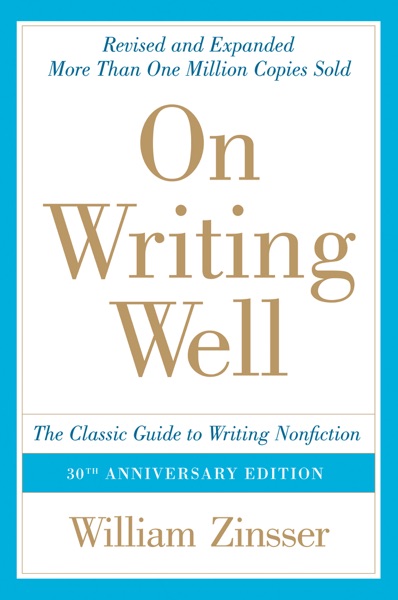
On Writing Well is William Zinsser's case that good nonfiction writing is not a talent you either have or don't, but a craft built on a small number of learnable principles — most of them reducible to the instruction to cut. First published in 1976 and updated through seven editions, it is one of the most-read books about writing in English, used in classrooms and read voluntarily by people who want to write more clearly, whether in books, journalism, business communications, or anything else.
The core diagnosis is clutter. Zinsser argues that most weak writing fails not because the writer lacks ideas but because those ideas are buried under unnecessary words: pompous phrasing, redundant qualifiers, weak verbs padded with adverbs, jargon deployed to signal expertise rather than convey information. His prescription is surgical: every sentence should contain only what is needed. If a word can be cut without losing meaning, cut it. If a sentence can be simplified without losing precision, simplify it. He demonstrates this through worked examples, showing before and after versions of actual sentences.
What it gets right
- 1.
Clutter is the disease of American writing. The cure is to count every word and cut every one that doesn't carry its weight.
- 2.
Clear writing is not simple writing; it is writing where complex ideas are expressed without unnecessary ceremony. Simplicity of expression and depth of thought are compatible.
- 3.
The writer's voice — specific, personal, recognizable — is what keeps readers reading. Generic prose sounds like nobody and therefore interests nobody.
What it covers
Who wrote it
William Zinsser (1922–2015) was an American writer and editor whose career spanned six decades. He was a journalist and critic at the New York Herald Tribune, a longtime teacher at Yale, and an editor at the Book-of-the-Month Club. He wrote more than a dozen books, but On Writing Well — first published in 1976 and revised seven times through 2006 — is by far his most widely read. It is used in journalism and English programs around the world and is one of the few writing books that consistently improves the writing of people who read it. Zinsser also wrote books about American places, music, and his own career.
