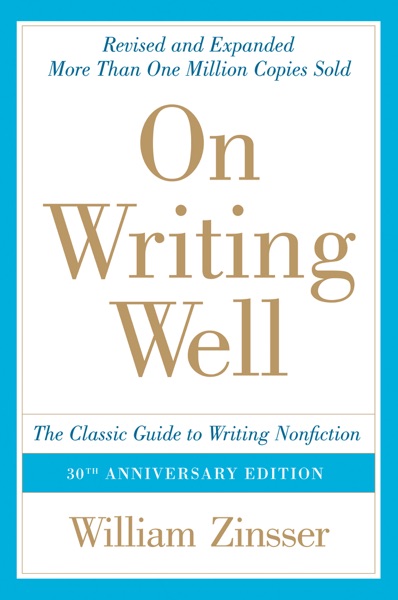
On Writing Well by William Zinsser is a 1976 self-help book about writing, clarity, craft. Clutter is the disease of American writing. The cure is to count every word and cut every one that doesn't carry its weight.
Summary
On Writing Well is William Zinsser's case that good nonfiction writing is not a talent you either have or don't, but a craft built on a small number of learnable principles — most of them reducible to the instruction to cut. First published in 1976 and updated through seven editions, it is one of the most-read books about writing in English, used in classrooms and read voluntarily by people who want to write more clearly, whether in books, journalism, business communications, or anything else.
The core diagnosis is clutter. Zinsser argues that most weak writing fails not because the writer lacks ideas but because those ideas are buried under unnecessary words: pompous phrasing, redundant qualifiers, weak verbs padded with adverbs, jargon deployed to signal expertise rather than convey information. His prescription is surgical: every sentence should contain only what is needed. If a word can be cut without losing meaning, cut it. If a sentence can be simplified without losing precision, simplify it. He demonstrates this through worked examples, showing before and after versions of actual sentences.
Beyond mechanics, Zinsser argues for authenticity. The writer's personality — specific, individual, human — should come through in their writing. The writer who tries to sound like a writer, or like a professional, or like an expert, produces work that sounds like nobody at all. Voice is not decoration; it is the reason a reader keeps reading. He has chapters on how to develop a voice, how to maintain interest across long pieces, and how to handle specific nonfiction forms including travel writing, science writing, memoirs, and business writing.
The book is written as it preaches: lean, direct, occasionally funny, and extremely rereadable. Zinsser spent decades teaching at Yale and editing at the Book-of-the-Month Club, and the authority in his voice comes from a working life spent with actual manuscripts. The prescriptions are clear, the examples are drawn from real published work, and the tone is demanding without being intimidating. Readers who follow the advice will write better — not because the principles are magical, but because they are correct.
Talk to On Writing Well like its author wrote you back.
Get the ideas that fit your life — not generic summaries.
- Chat with the book
- Audiobook-style main ideas
- Adapts to your life and goals
- Helps you take action
Key takeaways
- 1.
Clutter is the disease of American writing. The cure is to count every word and cut every one that doesn't carry its weight.
- 2.
Clear writing is not simple writing; it is writing where complex ideas are expressed without unnecessary ceremony. Simplicity of expression and depth of thought are compatible.
- 3.
The writer's voice — specific, personal, recognizable — is what keeps readers reading. Generic prose sounds like nobody and therefore interests nobody.
- 4.
Strong verbs do more work than adverb-padded weak ones. 'She ran quickly' is worse than 'she sprinted.'
- 5.
Leads must work. The first sentence needs to pull the reader in; the first paragraph must give a reason to keep going. Readers have other things to do.
- 6.
Every piece of writing has a unity of form and purpose. Know what you are writing before you start, then cut everything that doesn't serve that purpose.
- 7.
Writing is not a transcription of thinking; it is a form of thinking. Confused writing almost always reflects confused thought, not just weak expression.
- 8.
Rewriting is where the work happens. Most writers don't revise enough. Every draft should be shorter and clearer than the one before it.
Discussion questions
Use these on your own, with a book club, or as chat starters in Superbook. Book club version, ready to copy or print →
- 1.
Zinsser says clutter is the primary problem in most writing. Look at something you wrote recently — an email, a report, a message. How much of it could you cut without losing anything?
- 2.
He argues that voice is the thing that makes writing worth reading. Who is a writer — in any form — whose voice you find distinctly pleasurable? What makes it work?
- 3.
Zinsser distinguishes between clarity of expression and simplicity of thought. Are there topics you hesitate to write about because you fear sounding simple? Is that fear accurate?
- 4.
He insists that rewriting is the real craft. How much do you actually revise what you write, and what usually stops you from revising more?
- 5.
The book was first published in 1976 and has been updated through seven editions. What in the core advice has aged, and what is as true now for email and social media as it was for journalism?
- 6.
Zinsser writes about finding and keeping a consistent voice across different forms — travel writing, science writing, memoir. What is the voice you have that you might not be using enough?
- 7.
He says writing is a form of thinking, not just a transcription of it. Have you ever discovered what you actually thought about something by writing it out? What changed in the writing?
- 8.
His chapters on business writing argue that corporate prose has specific pathologies — jargon, passive voice, abstraction — that make it unreadable. Where do you see those pathologies most egregiously?
- 9.
Zinsser says leads need to earn the reader's continued attention. How often do you decide, based on the first paragraph, whether to keep reading something?
- 10.
He covers memoir specifically: the problem of writing about yourself without being self-indulgent. What is the difference between a memoir that earns its personal material and one that doesn't?
- 11.
The book's own prose is a demonstration of its principles. What specific choices does Zinsser make in his writing that you'd like to borrow?
- 12.
If you applied Zinsser's cutting principle aggressively to one thing you communicate regularly, what would that be and what would it look like after the cuts?
Themes
Frequently asked questions
-
Is On Writing Well useful for fiction writers?
Partly. The core principles — cut clutter, find your voice, know your purpose — apply to all writing. But the book is explicitly about nonfiction. Chapters on journalism, travel writing, and memoir are specific to those forms. Fiction writers will find the first half more useful than the second.
-
Which edition of On Writing Well should I read?
The seventh edition (2006) is the most current and includes chapters on digital and business writing that earlier editions lack. Any edition from the fourth onward covers the core material well. The first edition is a historical artifact — interesting but incomplete.
-
What's the most useful single exercise from the book?
Take something you wrote — an email, a paragraph, a short piece — and cut it by thirty percent. Not by removing ideas, but by cutting words that add no information. Zinsser describes this as the most direct path to better writing because it forces you to identify what the sentence is actually doing.
-
How does On Writing Well compare to Strunk and White's Elements of Style?
Strunk and White is shorter, more prescriptive, and more about grammatical rules. Zinsser is longer, more about principles and approach, and more forgiving of rule-breaking for voice. They are complementary. Elements of Style is for mechanics; On Writing Well is for everything else.
-
Is this book worth reading if you don't write professionally?
Yes. Most professional work involves communicating in writing — emails, reports, presentations, documentation. Zinsser's principles apply directly to all of these. Clearer writing produces clearer thinking, which produces better outcomes in any field.