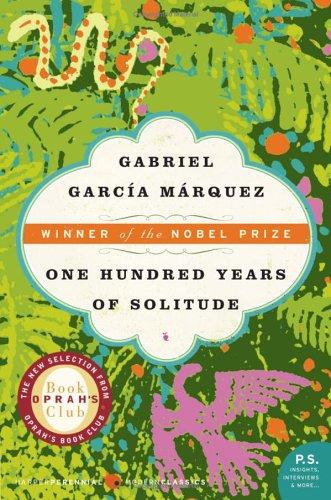
Talk to One Hundred Years of Solitude like its author wrote you back.
Get the ideas that fit your life — not generic summaries.
- Chat with the book
- Audiobook-style main ideas
- Adapts to your life and goals
- Helps you take action
One Hundred Years of Solitude, in detail
One Hundred Years of Solitude chronicles the founding, flourishing, and eventual obliteration of Macondo, a fictional Colombian town, through six generations of the Buendía family. It begins with the patriarch José Arcadio Buendía leading a group of settlers into the wilderness and ends with the last of the family, Aureliano, reading a manuscript that turns out to be the novel itself. In between, the family is visited by plagues of insomnia, a supernatural rainstorm lasting four years, the massacres of banana plantation workers, and the recurring cycles of war, love, obsession, and forgetting that constitute the novel's history.
García Márquez works in the mode known as magical realism, where the supernatural is reported with the same deadpan matter-of-factness as the quotidian. A priest levitates after drinking chocolate. A woman ascends to heaven while folding sheets. The dead return to visit the living without anyone finding this particularly alarming. This isn't whimsy — it is a way of rendering how myth, memory, and history coexist in a culture that García Márquez knew intimately: Caribbean Colombia, with its Catholic mysticism, its political carnage, and its history of exploitation by foreign capital.
The novel's central motif is repetition. Each generation reproduces the same types — the solitary intellectual, the passionate sensualist, the fierce military man — and makes the same mistakes. The names recur (there are dozens of characters called Aureliano or José Arcadio), and the narrative voice refuses to distinguish between them too sharply, as if individual identity were always dissolving back into type. This is simultaneously funny, melancholy, and deeply political: the cyclical history of Macondo mirrors Latin America's actual history, where coups, foreign interventions, and popular uprisings follow one after another with agonizing repetition.
This is a long, ambitious novel that requires engagement with a large cast and a non-linear sense of time. Readers who try to track every character will get lost; readers who surrender to the book's dream logic and follow its emotional current will find it one of the most alive experiences in fiction. It won the Nobel Prize in 1982. It is not a comfortable read, but it is an irreplaceable one.
The big ideas
- 1.
Magical realism in García Márquez isn't decoration — it is a way of writing how a culture actually experiences reality, where myth and material history are not separate.
- 2.
The Buendía family's tragedy is insolvable because it is also their character. Their solitude, their obsessions, their incapacity for love are not accidents but inheritances.
- 3.
Repetition is the novel's structural argument: the same types, the same names, the same mistakes across generations, mirroring Latin America's political cycles.
