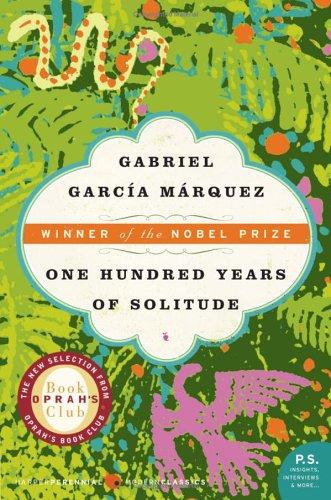
One Hundred Years of Solitude by Gabriel García Márquez is a 1967 literary fiction book about solitude and isolation, cyclical history, myth and reality. Magical realism in García Márquez isn't decoration — it is a way of writing how a culture actually experiences reality, where myth and material history are not separate.
Summary
One Hundred Years of Solitude chronicles the founding, flourishing, and eventual obliteration of Macondo, a fictional Colombian town, through six generations of the Buendía family. It begins with the patriarch José Arcadio Buendía leading a group of settlers into the wilderness and ends with the last of the family, Aureliano, reading a manuscript that turns out to be the novel itself. In between, the family is visited by plagues of insomnia, a supernatural rainstorm lasting four years, the massacres of banana plantation workers, and the recurring cycles of war, love, obsession, and forgetting that constitute the novel's history.
García Márquez works in the mode known as magical realism, where the supernatural is reported with the same deadpan matter-of-factness as the quotidian. A priest levitates after drinking chocolate. A woman ascends to heaven while folding sheets. The dead return to visit the living without anyone finding this particularly alarming. This isn't whimsy — it is a way of rendering how myth, memory, and history coexist in a culture that García Márquez knew intimately: Caribbean Colombia, with its Catholic mysticism, its political carnage, and its history of exploitation by foreign capital.
The novel's central motif is repetition. Each generation reproduces the same types — the solitary intellectual, the passionate sensualist, the fierce military man — and makes the same mistakes. The names recur (there are dozens of characters called Aureliano or José Arcadio), and the narrative voice refuses to distinguish between them too sharply, as if individual identity were always dissolving back into type. This is simultaneously funny, melancholy, and deeply political: the cyclical history of Macondo mirrors Latin America's actual history, where coups, foreign interventions, and popular uprisings follow one after another with agonizing repetition.
This is a long, ambitious novel that requires engagement with a large cast and a non-linear sense of time. Readers who try to track every character will get lost; readers who surrender to the book's dream logic and follow its emotional current will find it one of the most alive experiences in fiction. It won the Nobel Prize in 1982. It is not a comfortable read, but it is an irreplaceable one.
Talk to One Hundred Years of Solitude like its author wrote you back.
Get the ideas that fit your life — not generic summaries.
- Chat with the book
- Audiobook-style main ideas
- Adapts to your life and goals
- Helps you take action
Key takeaways
- 1.
Magical realism in García Márquez isn't decoration — it is a way of writing how a culture actually experiences reality, where myth and material history are not separate.
- 2.
The Buendía family's tragedy is insolvable because it is also their character. Their solitude, their obsessions, their incapacity for love are not accidents but inheritances.
- 3.
Repetition is the novel's structural argument: the same types, the same names, the same mistakes across generations, mirroring Latin America's political cycles.
- 4.
The banana company massacre — a direct reference to the 1928 Banana Massacre in Colombia — is presented as immediately forgotten by official history, which is one of the novel's most politically charged moments.
- 5.
Remedios the Beauty, who ascends into heaven, is treated not as a miracle but as a kind of limit case: beauty so absolute it becomes indifferent to the world.
- 6.
The final Aureliano's discovery that he has been reading about himself — and that the moment of reading is the moment of destruction — frames the whole novel as a closed loop, written by Melquíades before it happened.
- 7.
Female characters like Úrsula and Pilar Ternera carry the actual continuity of Macondo: its practical life, its memory, its emotional survival, while the men pursue abstraction and war.
- 8.
García Márquez renders colonial extraction and political violence without didacticism — the horror accumulates in the same matter-of-fact tone as the flying carpets and the rain of yellow flowers.
Discussion questions
Use these on your own, with a book club, or as chat starters in Superbook. Book club version, ready to copy or print →
- 1.
The novel uses the same names for dozens of characters across generations. Is this a flaw in navigation or a deliberate argument about identity and repetition? Did it frustrate you?
- 2.
Magical realism presents miracles and massacres with equal composure. What does this tone do that a realist account of the same events couldn't?
- 3.
Úrsula outlives most of the novel, watching generations of Buendías make the same mistakes. What is her function — witness, conscience, or something else?
- 4.
The banana company massacre is forgotten almost immediately in the novel's world. García Márquez is referencing a real historical event. What does the erasure of historical violence mean to you in 2026?
- 5.
The men of the novel are mostly incapable of genuine connection despite (or because of) their obsessive loves and wars. Is solitude a condition in this novel or a choice?
- 6.
Colonel Aureliano Buendía fights thirty-two civil wars and loses all thirty-two. The novel presents this with dark comedy. What is García Márquez doing with that?
- 7.
The ending is one of the most celebrated in twentieth-century fiction. Did it feel earned, or like a clever trick?
- 8.
Latin America's history of coups, foreign corporate exploitation, and mass violence runs through this novel as subtext. How much did knowing that history change your reading?
- 9.
Compared to Beloved — another novel about what cannot be escaped from the past — where does One Hundred Years land differently?
- 10.
The novel was published in 1967. Does it feel dated, or does it feel like it's describing the present?
- 11.
Which Buendía did you find most compelling, and why?
- 12.
García Márquez said he began the novel by imagining a father taking his son to see ice for the first time. Does that opening scene set the register for the whole book?
Themes
Frequently asked questions
-
Is One Hundred Years of Solitude hard to read?
The repeated names are the main obstacle — dozens of characters share a handful of names across generations. Keeping a family tree (many editions include one) helps significantly. The prose, in Gregory Rabassa's translation, is extraordinarily beautiful and flows easily. The challenge is navigating the cast, not the prose itself.
-
What is the book about, in one sentence?
The rise and fall of a family and a fictional Colombian town over six generations, told in a style where magic and violence coexist as equally ordinary facts of life.
-
Why is it considered one of the greatest novels ever written?
It invented a way of writing that felt both distinctly Latin American and universally applicable. The blend of myth, political history, comedy, and tragedy in a single sustained tone had never been done quite this way. It changed what writers worldwide thought the novel could do.
-
Who shouldn't read One Hundred Years of Solitude?
Readers who need to track every character closely will exhaust themselves. Readers who require a sympathetic protagonist will find no one to fully root for. And readers who want momentum — plot that builds toward a clear climax — may find the novel's cyclical structure frustrating.
-
Is there a film or TV adaptation?
Netflix released a Spanish-language adaptation in 2024. García Márquez famously refused to sell film rights during his lifetime, believing the novel's magic couldn't survive translation to screen. The Netflix series has been praised for the ambition of the attempt.