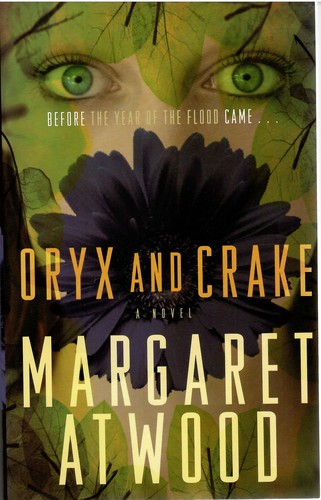
Talk to Oryx and Crake like its author wrote you back.
Get the ideas that fit your life — not generic summaries.
- Chat with the book
- Audiobook-style main ideas
- Adapts to your life and goals
- Helps you take action
What it argues
Snowman — formerly Jimmy — may be the last human being alive. He lives at the edge of a genetically engineered world that has been emptied of human civilization, tending to a group of gentle, naive creatures called Crakers who were designed to replace us. The novel moves between the present — Snowman scavenging for supplies and barely surviving — and his past, reconstructing the world before the catastrophe and the two people who shaped it: Crake, his brilliant, remote best friend who became a genetic engineer of terrifying capability, and Oryx, the mysterious woman they both loved and who exists in his memory with an almost mythological opacity.
The world Atwood built for this novel is a recognizable extrapolation of biotech capitalism: a world divided between corporate Compounds where scientists and their families live in comfortable surveillance, and the Pleeblands where everyone else scrambles in poverty and disorder. Pharmaceutical companies run human trials on the poor; extinct animals are resurrected for entertainment; children learn biology by watching executions online. Atwood draws from actual scientific research and corporate practice, which makes the satire pointed rather than speculative. The question isn't whether this could happen but how many of the preconditions are already present.
What it gets right
- 1.
The Compound/Pleebland divide is the novel's central socioeconomic critique: corporate biotech doesn't eliminate class, it hardens and securitizes it.
- 2.
Crake's plan isn't portrayed as the act of a madman but as the logical conclusion of his worldview — a feature, not a bug, which makes it far more disturbing.
- 3.
Oryx is deliberately kept opaque — Jimmy projects meaning onto her, Crake uses her instrumentally, and the reader can never fully access who she actually is.
What it covers
Who wrote it
Margaret Atwood is a Canadian poet, novelist, and essayist whose work spans literary fiction, speculative fiction, and cultural criticism. Born in 1939, she has published more than fifty books, including The Handmaid's Tale, Alias Grace, The Blind Assassin, and the MaddAddam trilogy. She has won the Booker Prize twice, the Arthur C. Clarke Award, and the PEN Pinter Prize, among many other honors. She is known for her refusal to be categorized, her political engagement, and her insistence on grounding speculative fiction in documented human behavior.
