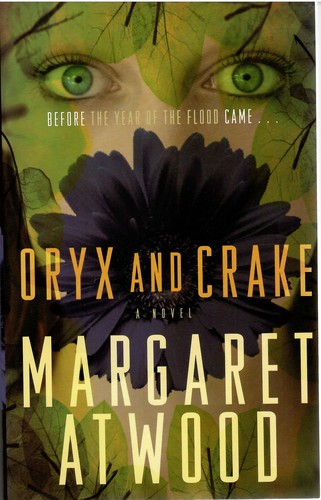
Oryx and Crake by Margaret Atwood is a 2003 science fiction book about biotechnology and ethics, class and segregation, love and obsession. The Compound/Pleebland divide is the novel's central socioeconomic critique: corporate biotech doesn't eliminate class, it hardens and securitizes it.
Summary
Snowman — formerly Jimmy — may be the last human being alive. He lives at the edge of a genetically engineered world that has been emptied of human civilization, tending to a group of gentle, naive creatures called Crakers who were designed to replace us. The novel moves between the present — Snowman scavenging for supplies and barely surviving — and his past, reconstructing the world before the catastrophe and the two people who shaped it: Crake, his brilliant, remote best friend who became a genetic engineer of terrifying capability, and Oryx, the mysterious woman they both loved and who exists in his memory with an almost mythological opacity.
The world Atwood built for this novel is a recognizable extrapolation of biotech capitalism: a world divided between corporate Compounds where scientists and their families live in comfortable surveillance, and the Pleeblands where everyone else scrambles in poverty and disorder. Pharmaceutical companies run human trials on the poor; extinct animals are resurrected for entertainment; children learn biology by watching executions online. Atwood draws from actual scientific research and corporate practice, which makes the satire pointed rather than speculative. The question isn't whether this could happen but how many of the preconditions are already present.
The narrative structure is deliberate and precise. Atwood withholds the nature of the catastrophe until near the end, which means the horror accumulates slowly through implication. The characters — especially Crake — are drawn with psychological specificity that keeps the reader from settling into easy judgments. Crake's project is monstrous by any conventional measure, but his reasoning is internally coherent, which is more disturbing than simple villainy would be.
Readers who respond to Atwood's combination of speculative rigor and psychological acuity will find this among her best novels. The pacing in the middle sections, following Jimmy through adolescence and young adulthood, is deliberate and requires patience. Those who want the novel to declare a moral more clearly than it does may find the ending deliberately unsatisfying. This is the first volume of the MaddAddam trilogy; the subsequent books expand the world but this one stands alone.
Talk to Oryx and Crake like its author wrote you back.
Get the ideas that fit your life — not generic summaries.
- Chat with the book
- Audiobook-style main ideas
- Adapts to your life and goals
- Helps you take action
Key takeaways
- 1.
The Compound/Pleebland divide is the novel's central socioeconomic critique: corporate biotech doesn't eliminate class, it hardens and securitizes it.
- 2.
Crake's plan isn't portrayed as the act of a madman but as the logical conclusion of his worldview — a feature, not a bug, which makes it far more disturbing.
- 3.
Oryx is deliberately kept opaque — Jimmy projects meaning onto her, Crake uses her instrumentally, and the reader can never fully access who she actually is.
- 4.
The Crakers' engineered innocence raises the question of what gets lost when you design out the parts of humanity that cause suffering: the answer seems to be most of what makes us interesting.
- 5.
Atwood's future is built from present-day corporate and scientific practice. The BlyssPluss pill, the organ farms, the viral marketing — the satire is recognizable because the originals exist.
- 6.
Jimmy's mediocrity is the novel's narrative engine: he is the type of person who falls through the cracks of systems designed to reward the exceptional, and so he sees the system more clearly.
- 7.
Snowman's guilt — his survival, his complicity, his failure to act — is never resolved. The novel refuses to let him, or the reader, off the hook.
- 8.
The novel's title names two absent figures. Both Oryx and Crake are gone before the story begins, and the whole book is Snowman's attempt to make sense of what they meant.
Discussion questions
Use these on your own, with a book club, or as chat starters in Superbook. Book club version, ready to copy or print →
- 1.
Crake argues that Homo sapiens are a failed species and his solution is the only rational response. Can you construct the strongest version of his case? Where does it break down?
- 2.
Oryx is never fully known — to Jimmy, to Crake, or to the reader. Is that opacity a limitation of the novel, or is it the point Atwood is making about how men perceive women?
- 3.
The Compound/Pleebland divide maps onto contemporary debates about gated communities, tech company campuses, and private school systems. How far does the analogy hold?
- 4.
Jimmy is not gifted in the way Crake is, and both of them know it. How does that power imbalance shape their friendship, and does the novel suggest Jimmy was used by Crake from the beginning?
- 5.
The Crakers were engineered to lack many human traits: violence, hierarchy, sexual jealousy, religious instinct. Which of these do you think Atwood views as most fundamental to what we are?
- 6.
Snowman lies to the Crakers about the nature of Crake and Oryx, essentially founding a religion. Is this presented as necessary, manipulative, tender, or all three?
- 7.
The novel is set in the near future but drawn from present conditions. Which element of Atwood's speculation felt most prescient or most already-here when you were reading?
- 8.
Compared to The Handmaid's Tale, Oryx and Crake takes on corporate capitalism rather than religious patriarchy. Which dystopia does Atwood seem more personally invested in?
- 9.
Jimmy's mother's decision to defect from the Compound is presented sympathetically but also has devastating consequences. How does the novel evaluate her?
- 10.
The ending leaves Snowman facing three Crakers and what may be another human survivor. Does the novel give you enough to speculate on what he will do, and what do you think that says?
- 11.
The Crakers have built-in peacekeeping mechanisms — purring that resolves conflict, for instance. Is this presented as utopian, horrifying, or something the novel refuses to adjudicate?
- 12.
The novel's title points to two people who shape the story but both die before its present tense. What does Atwood achieve by centering the book on someone defined by absence and grief?
Themes
Frequently asked questions
-
Is Oryx and Crake worth reading?
Yes. It's among the best biotech dystopia novels in English, and it's particularly good on how corporate capitalism shapes what science gets done and who benefits. The pacing requires patience in the middle third, but the payoff is substantial.
-
Do I need to read the rest of the MaddAddam trilogy?
Oryx and Crake stands completely alone. The Year of the Flood and MaddAddam expand the world and add characters but are not required for this novel's story. Many readers find this the strongest of the three.
-
How does Oryx and Crake compare to The Handmaid's Tale?
Both are dystopias, but the target is different. The Handmaid's Tale focuses on patriarchy and theocracy; Oryx and Crake takes on biotech capitalism and corporate segregation. This novel is more scientifically detailed and more satirical; The Handmaid's Tale is more emotionally immediate.
-
Is there an adaptation?
Not of this novel specifically, though the world appears briefly in the Hulu Handmaid's Tale series. A standalone adaptation has been discussed but not produced.
-
Who might not enjoy this book?
Readers who want a fast plot will struggle with the middle section, which follows Jimmy through a fairly ordinary adolescence in the Compound. The horror is cumulative rather than immediate, and the ending withholds resolution. If you need emotional catharsis, this may frustrate.