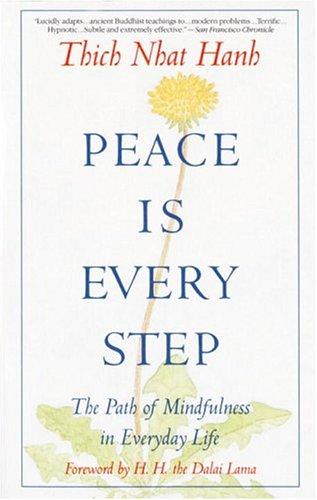
Talk to Peace Is Every Step like its author wrote you back.
Get the ideas that fit your life — not generic summaries.
- Chat with the book
- Audiobook-style main ideas
- Adapts to your life and goals
- Helps you take action
What it argues
Peace Is Every Step is Thich Nhat Hanh's most accessible work — a short, warmly written invitation to bring mindfulness practice into the texture of daily life. Compiled from his talks and writings by Arnold Kotler, it covers three broad areas: the art of mindful living (breathing, walking, eating, driving), the cultivation of inner peace, and the extension of that inner peace outward to relationships, community, and the wider world. Each short chapter — rarely more than three pages — introduces one practice or insight and invites immediate application.
The core teaching is simple but demanding: peace is not a future state to be achieved after practice but the quality of attention available right now, in this breath, this step. Nhat Hanh's famous phrase "the present moment is the only moment available to us" is not a truism but a challenge. Most of us spend most of our time mentally elsewhere — planning, rehearsing, regretting — and the result is a pervasive low-grade disconnection from our actual experience. Mindfulness is the practice of returning, again and again, to what is actually happening.
What it gets right
- 1.
Peace is not a future state but the quality of awareness available in the present moment — in this breath, this step, this cup of tea.
- 2.
Mindful breathing is the most fundamental practice: simply returning attention to the breath interrupts the mental chatter that generates anxiety and disconnection.
- 3.
Walking meditation — attending to each step fully — transforms an ordinary transit into a practice of presence available anywhere, anytime.
What it covers
Who wrote it
Thich Nhat Hanh (1926–2022) was a Vietnamese Zen Buddhist monk, poet, and peace activist. Exiled from Vietnam in 1966 for his opposition to the war, he lived primarily in France, where he founded Plum Village monastery and taught until his stroke in 2014. He was nominated for the Nobel Peace Prize by Martin Luther King Jr. and wrote more than a hundred books on Buddhism, mindfulness, and engaged practice. Peace Is Every Step, compiled from his talks and writings, introduced millions of Western readers to mindfulness practice in the early 1990s and remains one of the most widely read spiritual books of the 20th century.
