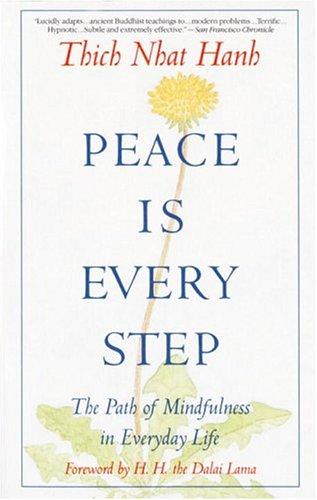
Peace Is Every Step by Thich Nhat Hanh is a 1991 religion & spirituality book about mindfulness, peace, present moment. Peace is not a future state but the quality of awareness available in the present moment — in this breath, this step, this cup of tea.
Summary
Peace Is Every Step is Thich Nhat Hanh's most accessible work — a short, warmly written invitation to bring mindfulness practice into the texture of daily life. Compiled from his talks and writings by Arnold Kotler, it covers three broad areas: the art of mindful living (breathing, walking, eating, driving), the cultivation of inner peace, and the extension of that inner peace outward to relationships, community, and the wider world. Each short chapter — rarely more than three pages — introduces one practice or insight and invites immediate application.
The core teaching is simple but demanding: peace is not a future state to be achieved after practice but the quality of attention available right now, in this breath, this step. Nhat Hanh's famous phrase "the present moment is the only moment available to us" is not a truism but a challenge. Most of us spend most of our time mentally elsewhere — planning, rehearsing, regretting — and the result is a pervasive low-grade disconnection from our actual experience. Mindfulness is the practice of returning, again and again, to what is actually happening.
The book is distinctive in connecting personal peace to social peace. Nhat Hanh does not treat inner practice as separate from engagement with the world's suffering. The chapters on "Interbeing," environmental harm, and the suffering of those we see on television argue that genuine peace includes awareness of and response to the larger context. The mindful person does not escape into serenity but becomes more capable of responding to pain — their own and others' — without being overwhelmed.
The writing is characteristic Nhat Hanh: utterly plain, warm without being sentimental, and surprisingly spare. He makes no arguments in the philosophical sense; he simply describes what practice looks like and invites you to try it. This can frustrate readers looking for analysis, but it suits the book's purpose exactly. It is a pointing finger, not a map.
Talk to Peace Is Every Step like its author wrote you back.
Get the ideas that fit your life — not generic summaries.
- Chat with the book
- Audiobook-style main ideas
- Adapts to your life and goals
- Helps you take action
Key takeaways
- 1.
Peace is not a future state but the quality of awareness available in the present moment — in this breath, this step, this cup of tea.
- 2.
Mindful breathing is the most fundamental practice: simply returning attention to the breath interrupts the mental chatter that generates anxiety and disconnection.
- 3.
Walking meditation — attending to each step fully — transforms an ordinary transit into a practice of presence available anywhere, anytime.
- 4.
Anger, sadness, and fear are not enemies but visitors; meeting them with mindful attention rather than suppression or reaction transforms them.
- 5.
Interbeing means personal peace and social peace are not separate: the roots of war and environmental destruction are in the same patterns of mind — craving, fear, and delusion — that create personal suffering.
- 6.
The bell of mindfulness — any recurring sound or signal in daily life — can become an invitation to return to the present moment.
- 7.
Deep listening is a form of compassion: being fully present to another person without judgment or agenda is one of the rarest and most healing gifts.
- 8.
Washing dishes, driving, and eating are complete practices of mindfulness when done with full attention — there is nothing more sacred available elsewhere.
Discussion questions
Use these on your own, with a book club, or as chat starters in Superbook. Book club version, ready to copy or print →
- 1.
Nhat Hanh says the present moment is the only moment available. How much of your waking time do you estimate you actually spend in the present moment versus planning or rehearsing?
- 2.
He describes ordinary activities — washing dishes, driving — as full mindfulness practices when done with attention. Have you ever experienced that quality of presence in a mundane task?
- 3.
The teaching on anger says to hold it like a mother holds a crying baby — not suppress it, not act it out, but tend to it. Have you ever tried that approach? What happened?
- 4.
Nhat Hanh connects individual peace practice to environmental responsibility and social justice. Is that connection convincing, or does it seem like he is adding politics to a personal practice?
- 5.
The book is made up of very short chapters with no sustained argument. Is that a feature or a limitation? What kind of reader does it suit best?
- 6.
He says most of us live cut off from our own experience through constant mental commentary. What does your internal commentary sound like, and what is it mostly about?
- 7.
Deep listening means being fully present to another person without planning your response. When was the last time someone listened to you that way? What was it like?
- 8.
The bell of mindfulness turns an ordinary event into a practice cue. What signal in your daily environment could serve that function?
- 9.
Nhat Hanh's writing style is completely non-confrontational — he makes no demands, passes no judgment. Does that register as respect or as evasion?
- 10.
If you practiced even ten minutes of mindful walking every day, what do you think would change over three months?
- 11.
The book says peace is available right now. What is the most honest obstacle between you and that availability?
Themes
Frequently asked questions
-
Is Peace Is Every Step a good starting point for mindfulness?
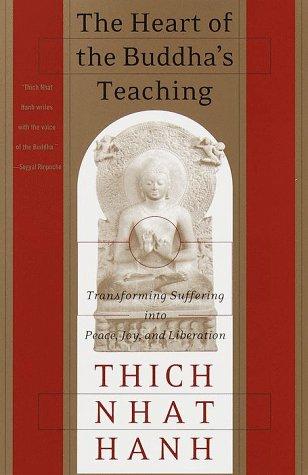
Yes, especially for readers who want practical guidance rather than doctrine. Each chapter introduces a simple practice or insight. Its main limitation is brevity — it points at practices but does not teach them in depth. Nhat Hanh's The Heart of the Buddha's Teaching covers more ground.
-
How long is Peace Is Every Step?
About 120 pages in most editions, readable in two to three hours. The short-chapter format makes it easy to read a few pages and pause to practice, which is how Nhat Hanh intends it.
-
Is this book religious or secular?
It comes from the Buddhist tradition and reflects Nhat Hanh's Zen background, but it is written for readers of any background. The practices it describes require no doctrinal belief, though understanding the Buddhist framework deepens the context.
-
What makes Thich Nhat Hanh different from other mindfulness teachers?
His consistent connection of inner practice to social and political engagement — what he calls engaged Buddhism. Also his extraordinary warmth and accessibility. He presents mindfulness not as a performance-optimization technique but as a response to suffering, including the world's suffering.
-
What is the most important practice in this book?
Mindful breathing — returning attention to the breath in ordinary moments. Nhat Hanh returns to it throughout the book as the most accessible and fundamental practice, the one from which all others grow.