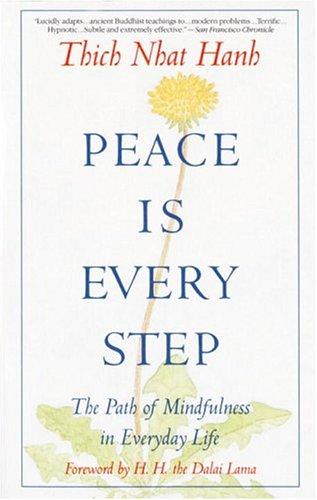
Talk to Peace Is Every Step like its author wrote you back.
Get the ideas that fit your life — not generic summaries.
- Chat with the book
- Audiobook-style main ideas
- Adapts to your life and goals
- Helps you take action
Peace Is Every Step, in detail
Peace Is Every Step is Thich Nhat Hanh's most accessible work — a short, warmly written invitation to bring mindfulness practice into the texture of daily life. Compiled from his talks and writings by Arnold Kotler, it covers three broad areas: the art of mindful living (breathing, walking, eating, driving), the cultivation of inner peace, and the extension of that inner peace outward to relationships, community, and the wider world. Each short chapter — rarely more than three pages — introduces one practice or insight and invites immediate application.
The core teaching is simple but demanding: peace is not a future state to be achieved after practice but the quality of attention available right now, in this breath, this step. Nhat Hanh's famous phrase "the present moment is the only moment available to us" is not a truism but a challenge. Most of us spend most of our time mentally elsewhere — planning, rehearsing, regretting — and the result is a pervasive low-grade disconnection from our actual experience. Mindfulness is the practice of returning, again and again, to what is actually happening.
The book is distinctive in connecting personal peace to social peace. Nhat Hanh does not treat inner practice as separate from engagement with the world's suffering. The chapters on "Interbeing," environmental harm, and the suffering of those we see on television argue that genuine peace includes awareness of and response to the larger context. The mindful person does not escape into serenity but becomes more capable of responding to pain — their own and others' — without being overwhelmed.
The writing is characteristic Nhat Hanh: utterly plain, warm without being sentimental, and surprisingly spare. He makes no arguments in the philosophical sense; he simply describes what practice looks like and invites you to try it. This can frustrate readers looking for analysis, but it suits the book's purpose exactly. It is a pointing finger, not a map.
The big ideas
- 1.
Peace is not a future state but the quality of awareness available in the present moment — in this breath, this step, this cup of tea.
- 2.
Mindful breathing is the most fundamental practice: simply returning attention to the breath interrupts the mental chatter that generates anxiety and disconnection.
- 3.
Walking meditation — attending to each step fully — transforms an ordinary transit into a practice of presence available anywhere, anytime.
