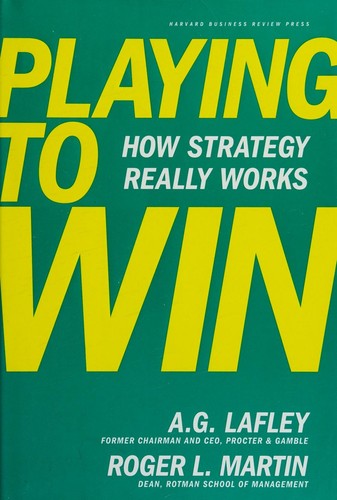
Talk to Playing to Win: How Strategy Really Works like its author wrote you back.
Get the ideas that fit your life — not generic summaries.
- Chat with the book
- Audiobook-style main ideas
- Adapts to your life and goals
- Helps you take action
Playing to Win: How Strategy Really Works, in detail
Playing to Win is Roger Martin and A.G. Lafley's account of the strategy framework Lafley used to turn Procter and Gamble around as CEO from 2000 to 2009 and then again from 2013 to 2015. Martin is a strategy professor at the Rotman School of Management who worked closely with Lafley throughout. The book is built around a single deceptively simple claim: strategy is a set of integrated choices, not a plan or a vision or a set of aspirations.
The framework centers on five choices that form the strategic cascade: the Winning Aspiration (what does winning look like?), Where to Play (which markets, geographies, channels, customers?), How to Win (what is your competitive advantage in the places you've chosen?), What Capabilities are Required (what activities and systems must you have?), and What Management Systems support those capabilities? The choices are integrated — each one constrains and enables the others. A change in where to play requires recalibrating how to win, which requires different capabilities, which requires different management systems. The cascade must be coherent or it produces incoherence in execution.
Martin and Lafley are particularly precise about the middle two choices: Where to Play and How to Win. These are the choices where most companies evade strategy by choosing too broadly, staying in every category they've historically been in, and competing on every dimension simultaneously. They argue that genuine strategic choice means saying no to markets and methods you are not going to pursue, which most organizations find deeply uncomfortable.
The book uses P&G's turnaround extensively — the repositioning of Olay as a premium brand, the acquisition of Gillette, the disposal of under-performing categories — to illustrate how the cascade works in practice. The framework is more actionable than most academic strategy frameworks and more intellectually grounded than most practitioner accounts. It rewards careful reading and is particularly useful for senior leaders who need to make and communicate real strategic choices.
The big ideas
- 1.
Strategy is an integrated set of five choices: Winning Aspiration, Where to Play, How to Win, Required Capabilities, and Management Systems. Each choice constrains and enables the others.
- 2.
Winning Aspiration is not a mission statement — it defines what success looks like in terms of customers, markets, and competitive position, not just internal goals.
- 3.
Where to Play must be explicit and specific. A company that tries to compete everywhere is not making a strategic choice — it is avoiding one.
