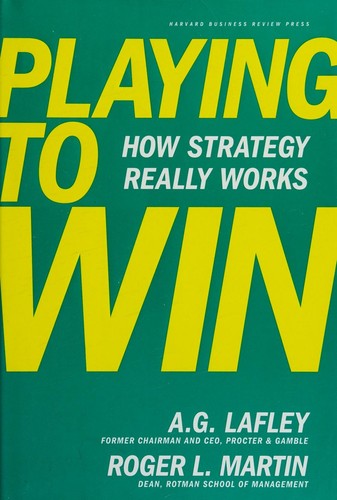
Playing to Win: How Strategy Really Works by Roger L. Martin and A.G. Lafley is a 2013 business book about strategy, competition, decision-making. Strategy is an integrated set of five choices: Winning Aspiration, Where to Play, How to Win, Required Capabilities, and Management Systems. Each choice constrains and enables the others.
Summary
Playing to Win is Roger Martin and A.G. Lafley's account of the strategy framework Lafley used to turn Procter and Gamble around as CEO from 2000 to 2009 and then again from 2013 to 2015. Martin is a strategy professor at the Rotman School of Management who worked closely with Lafley throughout. The book is built around a single deceptively simple claim: strategy is a set of integrated choices, not a plan or a vision or a set of aspirations.
The framework centers on five choices that form the strategic cascade: the Winning Aspiration (what does winning look like?), Where to Play (which markets, geographies, channels, customers?), How to Win (what is your competitive advantage in the places you've chosen?), What Capabilities are Required (what activities and systems must you have?), and What Management Systems support those capabilities? The choices are integrated — each one constrains and enables the others. A change in where to play requires recalibrating how to win, which requires different capabilities, which requires different management systems. The cascade must be coherent or it produces incoherence in execution.
Martin and Lafley are particularly precise about the middle two choices: Where to Play and How to Win. These are the choices where most companies evade strategy by choosing too broadly, staying in every category they've historically been in, and competing on every dimension simultaneously. They argue that genuine strategic choice means saying no to markets and methods you are not going to pursue, which most organizations find deeply uncomfortable.
The book uses P&G's turnaround extensively — the repositioning of Olay as a premium brand, the acquisition of Gillette, the disposal of under-performing categories — to illustrate how the cascade works in practice. The framework is more actionable than most academic strategy frameworks and more intellectually grounded than most practitioner accounts. It rewards careful reading and is particularly useful for senior leaders who need to make and communicate real strategic choices.
Talk to Playing to Win: How Strategy Really Works like its author wrote you back.
Get the ideas that fit your life — not generic summaries.
- Chat with the book
- Audiobook-style main ideas
- Adapts to your life and goals
- Helps you take action
Key takeaways
- 1.
Strategy is an integrated set of five choices: Winning Aspiration, Where to Play, How to Win, Required Capabilities, and Management Systems. Each choice constrains and enables the others.
- 2.
Winning Aspiration is not a mission statement — it defines what success looks like in terms of customers, markets, and competitive position, not just internal goals.
- 3.
Where to Play must be explicit and specific. A company that tries to compete everywhere is not making a strategic choice — it is avoiding one.
- 4.
How to Win defines the competitive advantage that justifies being in the chosen markets: cost leadership, differentiation, or a specific capability that no competitor can easily replicate.
- 5.
The five choices form a cascade: each level must be consistent with the choices above it and supported by the choices below. Incoherence anywhere in the cascade produces confused execution.
- 6.
Most strategy failures are not failures of execution — they are failures to make real choices. Keeping options open is not strategy; strategy requires commitment.
- 7.
Strategy is not planning. Plans detail activities to execute against a strategy. Strategy specifies the integrated set of choices that create and sustain competitive advantage.
- 8.
Reverse-engineering strategy: what must be true for this strategy to succeed? Identifying the conditions required for a strategic choice to work is the most disciplined form of strategic planning.
Discussion questions
Use these on your own, with a book club, or as chat starters in Superbook. Book club version, ready to copy or print →
- 1.
Martin and Lafley define strategy as an integrated set of five choices. What happens when an organization makes coherent choices at one level but incoherent choices at another?
- 2.
Genuine Where to Play choices require explicitly deciding where you are not going to compete. What makes that kind of explicit exclusion politically difficult in most organizations?
- 3.
Can a large, diversified company have a single coherent strategy, or does each business unit require its own strategic cascade? How do the cascades relate to each other?
- 4.
Martin is explicit that strategy requires taking risk and making irreversible commitments. In your experience, what is the cost of avoiding that commitment — of keeping all options open?
- 5.
Apply the five-choice cascade to a business you know well. Where is the cascade coherent, and where does it break down? What is the effect of the incoherence on the business?
- 6.
How to Win must produce a competitive advantage that is specific and defensible. What kinds of competitive advantages are most durable, and which erode fastest in digital markets?
- 7.
The book argues that good strategy requires saying no to attractive options. What's the most significant strategic no you've seen a company make, and what was the effect?
- 8.
Required Capabilities and Management Systems are the bottom two levels of the cascade. Why are they often underdeveloped in strategic plans that are otherwise strong at the top?
- 9.
Martin and Lafley use P&G as the primary case study. What are the limits of that example for companies that are not large consumer goods companies?
- 10.
How does Playing to Win's framework relate to Good Strategy Bad Strategy? Do they agree on what good strategy is, or are there meaningful differences?
- 11.
What is the difference between a strategy and a value proposition? Can you have a compelling value proposition without a coherent strategic cascade behind it?
Themes
Frequently asked questions
-
Is Playing to Win worth reading?
Yes. It provides a more operationally useful strategy framework than most academic books, grounded in a real turnaround case rather than theoretical constructs. The five-choice cascade is immediately applicable to strategic planning processes.
-
What is the strategic cascade in Playing to Win?
Five integrated choices that form a coherent strategy: Winning Aspiration, Where to Play, How to Win, Required Capabilities, and Management Systems. Each choice must be consistent with the others — the cascade collapses when choices at different levels are incoherent.
-
How does Playing to Win compare to Competitive Strategy?
Porter's Competitive Strategy is more analytical — it diagnoses industry structure and maps competitive positions. Playing to Win is more prescriptive — it provides a process for making strategic choices. Porter tells you what to analyze; Martin and Lafley tell you how to choose.
-
Does Playing to Win apply to small businesses and startups?
Yes, though the examples skew large-company. The cascade logic applies to any business that needs to choose where to compete and how to win there. Startups benefit especially from the discipline of Where to Play — the discipline of saying no to adjacent markets before the core is secure.
-
What is reverse-engineering strategy in Martin's framework?
Asking: what must be true for this strategic choice to succeed? Identifying the conditions required — market assumptions, customer behaviors, capability requirements — and then testing whether those conditions hold. It is the most rigorous way to stress-test a strategy before committing to it.