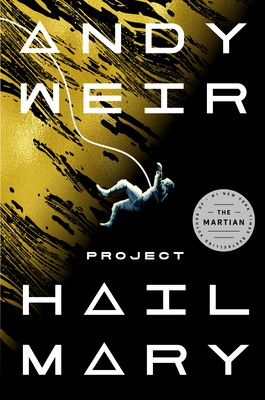
Talk to Project Hail Mary like its author wrote you back.
Get the ideas that fit your life — not generic summaries.
- Chat with the book
- Audiobook-style main ideas
- Adapts to your life and goals
- Helps you take action
What it argues
Ryland Grace wakes up alone on a spacecraft with no memory of who he is, where he is, or why he's there. The answers come back slowly: he is the sole surviving crew member of a one-way mission launched as a last-ditch attempt to save Earth from a microorganism called Astrophage that is draining energy from the sun. Grace is a junior-college science teacher who was recruited against his will, and he wakes up in deep space with a dead crew, a functional spacecraft, and a problem that will require him to become someone capable of solving it.
Project Hail Mary is structured as a problem-solving novel, like The Martian, but it has something The Martian doesn't: a relationship. About a third of the way through, Grace encounters another spacecraft — not human — and what follows is one of the most celebrated first-contact relationships in recent science fiction. Weir constructs an alien whose biology, physics, and communication work according to different rules, and the process of the two characters learning to understand each other becomes the emotional core of the novel. The friendship that develops is genuinely affecting in ways The Martian's isolation never quite was.
What it gets right
- 1.
The amnesia structure is not a gimmick — it lets Weir control information release and creates an unusual form of character discovery, where the protagonist is figuring out who he is at the same time the reader is.
- 2.
The first-contact relationship is built on physics and chemistry rather than language, which makes it feel more plausible than most SF alien communication scenarios.
- 3.
Sacrifice chosen freely, for someone you love, lands completely differently from sacrifice imposed by circumstance — Weir earns that distinction by building the relationship slowly.
What it covers
Who wrote it
Andy Weir is an American author and former software engineer whose debut novel The Martian, originally self-published on his website, became a bestseller and was adapted into a Ridley Scott film starring Matt Damon. Project Hail Mary is his third novel, following The Martian (2011) and Artemis (2017). He is known for meticulous scientific research, problem-solving narratives, and a commitment to getting the physics right even when it complicates the story. He lives in California.
