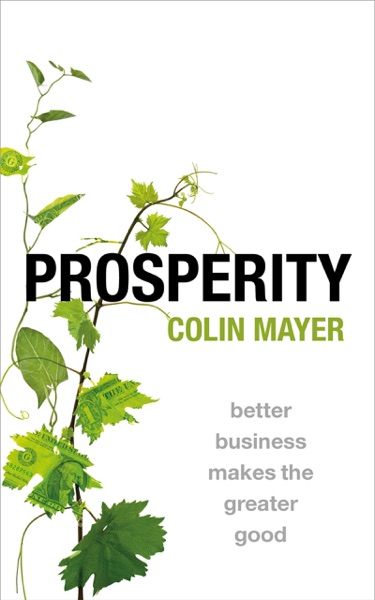
Talk to Prosperity: Better Business Makes the Greater Good like its author wrote you back.
Get the ideas that fit your life — not generic summaries.
- Chat with the book
- Audiobook-style main ideas
- Adapts to your life and goals
- Helps you take action
What it argues
Prosperity is Colin Mayer's argument that the modern corporation has lost its sense of purpose — and that recovering it requires not marginal adjustments but a fundamental rethinking of what corporations are for. Mayer, a professor at Oxford's Said Business School, wrote the book as part of the British Academy's Future of the Corporation project, and it reads like what it is: a rigorous, historically grounded proposal for institutional reform.
The central target is shareholder primacy — the doctrine, associated with Milton Friedman and institutionalized in corporate law and financial economics over the past fifty years, that the purpose of a corporation is to maximize returns to shareholders. Mayer argues that this doctrine is not only ethically problematic but historically anomalous and economically counterproductive. Corporations existed for centuries before shareholder primacy was invented, and the things we actually want corporations to do — solve complex problems, make long-term investments, earn trust — are systematically undermined by a governance structure optimized for quarterly returns.
What it gets right
- 1.
Shareholder primacy is not a natural feature of capitalism but a specific doctrine developed in the late twentieth century. Understanding this makes alternatives easier to imagine.
- 2.
The purpose of a corporation is not the same as its ownership structure. A corporation owned by shareholders does not automatically owe its primary obligation to shareholders.
- 3.
Profit is necessary for corporate survival and investment, but optimizing for profit maximization produces different outcomes than optimizing for the primary purpose the corporation was designed to serve.
What it covers
Who wrote it
Colin Mayer is a professor of management studies at the Said Business School, University of Oxford, and a fellow of the British Academy and the Royal Society of Arts. He chaired the British Academy's Future of the Corporation program, which produced Prosperity and influenced subsequent corporate governance reform discussions in the UK. He has advised governments and central banks on financial regulation and corporate governance and is widely regarded as one of the leading thinkers on corporate purpose.
