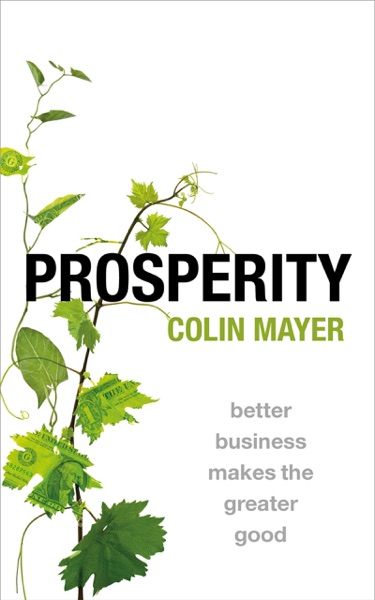
Prosperity: Better Business Makes the Greater Good by Colin Mayer is a 2018 economics book about corporate purpose, capitalism, governance. Shareholder primacy is not a natural feature of capitalism but a specific doctrine developed in the late twentieth century. Understanding this makes alternatives easier to imagine.
Summary
Prosperity is Colin Mayer's argument that the modern corporation has lost its sense of purpose — and that recovering it requires not marginal adjustments but a fundamental rethinking of what corporations are for. Mayer, a professor at Oxford's Said Business School, wrote the book as part of the British Academy's Future of the Corporation project, and it reads like what it is: a rigorous, historically grounded proposal for institutional reform.
The central target is shareholder primacy — the doctrine, associated with Milton Friedman and institutionalized in corporate law and financial economics over the past fifty years, that the purpose of a corporation is to maximize returns to shareholders. Mayer argues that this doctrine is not only ethically problematic but historically anomalous and economically counterproductive. Corporations existed for centuries before shareholder primacy was invented, and the things we actually want corporations to do — solve complex problems, make long-term investments, earn trust — are systematically undermined by a governance structure optimized for quarterly returns.
Mayer's alternative is a purpose-driven model in which corporations define a primary commitment that is not reducible to profit. Profit remains essential, but it is the means rather than the end — similar to how an individual needs food and shelter to pursue their life's goals without food being the goal itself. The practical implications are substantial: different ownership structures, different board accountability, different measurement frameworks, and different relationships with the communities in which corporations operate.
The book is more diagnostic than prescriptive — Mayer is more confident about what is wrong with shareholder primacy than about exactly what should replace it, and the final chapters on solutions are less fully worked out than the earlier chapters on the problem. But as an argument that the question "what is a corporation for?" deserves a more thoughtful answer than "whatever its shareholders want," Prosperity is clear and well-evidenced.
Talk to Prosperity: Better Business Makes the Greater Good like its author wrote you back.
Get the ideas that fit your life — not generic summaries.
- Chat with the book
- Audiobook-style main ideas
- Adapts to your life and goals
- Helps you take action
Key takeaways
- 1.
Shareholder primacy is not a natural feature of capitalism but a specific doctrine developed in the late twentieth century. Understanding this makes alternatives easier to imagine.
- 2.
The purpose of a corporation is not the same as its ownership structure. A corporation owned by shareholders does not automatically owe its primary obligation to shareholders.
- 3.
Profit is necessary for corporate survival and investment, but optimizing for profit maximization produces different outcomes than optimizing for the primary purpose the corporation was designed to serve.
- 4.
Trust is a corporate asset that is extremely difficult to build and easy to destroy. Short-term optimization regularly destroys it, which is why the relationship between shareholder primacy and corporate longevity is often negative.
- 5.
Different legal forms of ownership — employee ownership, long-term institutional ownership, family ownership — produce different time horizons and different relationships with stakeholders.
- 6.
Corporate governance determines what corporations actually optimize for. Board composition, accountability mechanisms, and measurement frameworks are not neutral — they shape behavior as much as incentives do.
- 7.
The commons problem: corporations that generate costs they don't pay for (pollution, inequality, instability) are effectively being subsidized by society. Better governance means internalizing those costs rather than externalizing them.
- 8.
The question of corporate purpose is not just philosophical — it is a regulatory and legal question. The answers embedded in company law shape every corporation operating under that law.
Discussion questions
Use these on your own, with a book club, or as chat starters in Superbook. Book club version, ready to copy or print →
- 1.
Mayer argues that shareholder primacy is a recent historical invention, not a fundamental feature of capitalism. Does that historical claim change how you think about whether it can or should be changed?
- 2.
If profit is the means rather than the end, what should the end be? How would you define corporate purpose for a company you work for or invest in?
- 3.
The book argues that purpose-driven companies perform better over the long run than shareholder-primacy companies. Is that an argument for purpose on its own terms, or does it undercut it — if purpose just maximizes long-run profit, is it really different?
- 4.
Mayer identifies trust as a key corporate asset that short-termism destroys. Can you think of a company you have personally stopped using or trusting because of short-term decisions? What specifically did they do?
- 5.
Employee-owned companies like John Lewis in the UK perform differently than publicly listed companies. What are the structural reasons for that difference, and are they always advantages?
- 6.
If you were redesigning corporate law from scratch, what single change would you make to better align corporate behavior with broader social interests?
- 7.
The critique of shareholder primacy is often framed as anti-capitalist. Mayer argues it is actually more pro-capitalism than the alternative. Does that framing change how you evaluate the argument?
- 8.
How does the question of corporate purpose play out differently in different industries — banking versus retail versus technology versus manufacturing?
- 9.
Mayer is an Oxford professor writing for a policy audience. What does the academic tone add or cost in terms of persuasiveness and usefulness to practitioners?
- 10.
The book acknowledges that purpose without profit is not viable. How do you draw the line between genuine purpose-driven behavior and purpose as marketing?
- 11.
Which corporations currently operating do you think come closest to Mayer's model of genuine purpose? What makes them different from the baseline?
- 12.
If shareholder primacy is as destructive as Mayer argues, why has it persisted and expanded globally rather than being reformed by the evidence? What political economy explanation accounts for its persistence?
Themes
Frequently asked questions
-
Is Prosperity relevant for people who are not in finance or corporate law?
Yes. The core argument — about what corporations should optimize for and how governance structures shape behavior — applies to anyone who works in, manages, invests in, or is affected by large organizations. The policy sections are more specialized, but the conceptual argument is broadly accessible.
-
How is Prosperity different from stakeholder capitalism arguments like those in Business Roundtable statements?
Mayer is more rigorous and more critical than most stakeholder capitalism rhetoric. He argues that vague commitments to stakeholder consideration without governance changes and legal reforms are insufficient and sometimes counterproductive. The book is more demanding than a corporate communications document.
-
Does Mayer think capitalism should be abolished?
No. He argues that capitalism, properly understood and governed, is the right framework for organizing economic activity. His target is a specific distortion of capitalism — shareholder primacy — not markets or private ownership per se.
-
What practical recommendations does Mayer make?
The prescriptive sections include recommending that companies formally articulate and commit to a purpose beyond profit, that ownership structures be reformed to extend time horizons, that measurement frameworks capture long-term value creation, and that corporate law be revised to reflect these priorities. He is more confident about direction than precise mechanism.
-
Who should read Prosperity?
People working in policy, governance, or finance; executives and board members thinking about corporate strategy and purpose; academics and students in business and economics; and general readers who want a rigorous treatment of why corporations behave as they do and how that might be changed.
Similar books
The Capitalist Manifesto: Why the Global Free Market Will Save the World
Johan Norberg
Capitalism and Freedom
Milton Friedman
Good to Great
Jim Collins
Brave New Work
Aaron Dignan
