Economics · Book club
Quit Like a Millionaire book club questions
Here are 12 book club questions for Quit Like a Millionaire by Kristy Shen, ordered to open easily and end somewhere worth arguing about. Copy them, print them, or bring them up one at a time.
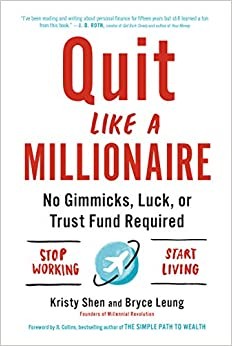
Quit Like a Millionaire is Kristy Shen and Bryce Leung's account of how they retired in their early thirties with a million-dollar portfolio assembled on middle-class incomes — and the mathematical framework that let them do it.
Kristy Shen · 2019 · 5h 45m
Full summary and key takeaways →The 12 questions
- 1.
Shen argues that savings rate matters more than income. What does your current savings rate suggest about your own FI timeline?
- 2.
The book opens with Shen's childhood poverty in China. How much did her starting point shape the financial philosophy she developed?
- 3.
The 4% rule is a guideline built on historical US market data. How comfortable are you applying it to a 40- or 50-year retirement horizon?
- 4.
Sequence-of-returns risk is largely invisible until a crash happens at the wrong time. How would you actually behave if markets dropped 40% in your first year of retirement?
- 5.
Shen is critical of homeownership as an investment. Does her math match your assumptions about real estate in your area?
- 6.
Geographic arbitrage — spending winters somewhere cheaper — is a real option for some retirees. What would you be giving up, and would it be worth it?
- 7.
The book distinguishes sharply between frugality and deprivation. Where is that line for you personally?
- 8.
Shen and Leung retired in their early thirties. What would you actually do with your time if you stopped working at that age?
- 9.
Healthcare costs represent one of the largest uncontrolled variables in early retirement planning. How are you thinking about that risk?
- 10.
The book argues that most people work far longer than necessary because they never do the math. Have you done the math?
- 11.
Shen describes FI as buying freedom, not buying things. What does freedom mean to you in practical daily terms?
- 12.
If your savings rate doubled tomorrow — same income, half the spending — what would you have to actually give up?
How to run the discussion
- Pick six to eight, not all of them. An hour of real discussion covers fewer questions than anyone expects, and racing the list is what makes a book club feel like homework.
- Open with what people noticed, not what they concluded. Asking for a verdict first hardens opinions before anyone has heard each other.
- Let the disagreement run. The questions below that split a room are the ones worth the time; the ones everyone answers the same way can be skipped.
- Ask the quiet person a specific question. A direct, narrow question is far easier to answer than an open invitation to contribute.
Themes worth steering toward
If the conversation stalls, these are the threads that usually restart it.
Common questions
What are good book club questions for Quit Like a Millionaire?
Here are 12 book club questions for Quit Like a Millionaire by Kristy Shen, ordered to open easily and end somewhere worth arguing about. The strongest openers ask what each reader noticed rather than what they concluded, and the discussion usually turns on financial independence, early retirement, frugality.
How long should a book club discussion of Quit Like a Millionaire last?
Most groups run 60 to 90 minutes of actual discussion. That is roughly six to eight questions, not all of them, so pick the ones that suit your group rather than working down the list in order.
What are the main themes in Quit Like a Millionaire?
Financial independence, Early retirement, Frugality, Investing, Lifestyle design. Those are the threads most likely to divide a room, which makes them the useful places to steer a discussion that has gone quiet.
Picking the next one? See books like Quit Like a Millionaire or questions for other book club picks.
