Talk to Rational Ritual like its author wrote you back.
Get the ideas that fit your life — not generic summaries.
- Chat with the book
- Audiobook-style main ideas
- Adapts to your life and goals
- Helps you take action
What it argues
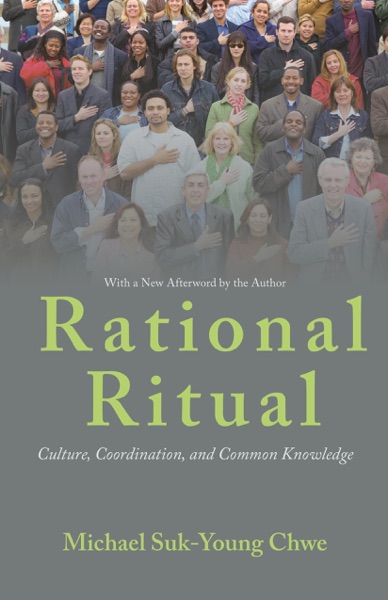
Rational Ritual is a short, elegant book about why certain kinds of social events — rituals, ceremonies, public spectacles, advertising in mass media — serve a function that private communication cannot. Michael Chwe, an economist and political scientist at UCLA, uses game theory to explain why people need not just information but common knowledge: not just knowing something, but knowing that others know it, and knowing that they know that you know it.
The core argument is built around a classic coordination problem. If you want to join a protest, it is not enough to want change and to know that others want change. You need to know that enough other people will also show up that showing up is safe. This requires common knowledge — a shared understanding that everyone has the same information. Private channels create information but not common knowledge. Public events, by putting everyone in the same room or in front of the same broadcast, solve the common knowledge problem that private information cannot.
What it gets right
- 1.
Common knowledge — everyone knowing that everyone else knows something — is fundamentally different from mere information, and much harder to create.
- 2.
Coordination problems require common knowledge. Showing up to a protest, joining a bank run, or attending a revolution requires not just personal will but the belief that enough others will also act.
- 3.
Public rituals and ceremonies exist partly to create common knowledge that private communication cannot. They put everyone in the same position simultaneously.
What it covers
Who wrote it
Michael Chwe is a professor of political science at the University of California, Los Angeles, where he works at the intersection of game theory, political economy, and cultural analysis. His research covers mechanism design, common knowledge, and the political logic of social conventions. Before Rational Ritual, he published technical work in journals including Econometrica and the Journal of Political Economy. He is also the author of Jane Austen, Game Theorist (2013), which argues that Austen's novels contain a sophisticated understanding of strategic thinking that anticipates modern game theory. Rational Ritual was originally published by Princeton University Press in 2001.
