Talk to Rational Ritual like its author wrote you back.
Get the ideas that fit your life — not generic summaries.
- Chat with the book
- Audiobook-style main ideas
- Adapts to your life and goals
- Helps you take action
Rational Ritual, in detail
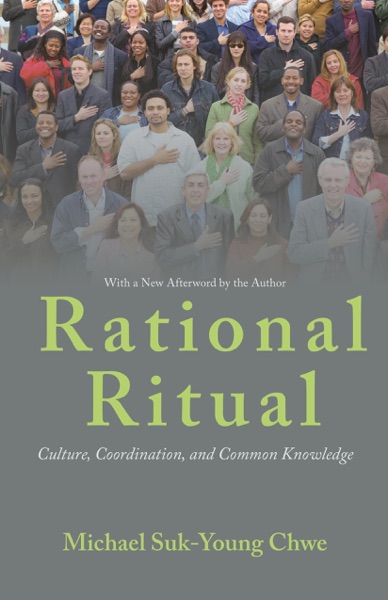
Rational Ritual is a short, elegant book about why certain kinds of social events — rituals, ceremonies, public spectacles, advertising in mass media — serve a function that private communication cannot. Michael Chwe, an economist and political scientist at UCLA, uses game theory to explain why people need not just information but common knowledge: not just knowing something, but knowing that others know it, and knowing that they know that you know it.
The core argument is built around a classic coordination problem. If you want to join a protest, it is not enough to want change and to know that others want change. You need to know that enough other people will also show up that showing up is safe. This requires common knowledge — a shared understanding that everyone has the same information. Private channels create information but not common knowledge. Public events, by putting everyone in the same room or in front of the same broadcast, solve the common knowledge problem that private information cannot.
Chwe applies this framework to an unusually wide range of phenomena: royal ceremonies and coronations, Super Bowl advertising, political rallies, religious rituals, marriage ceremonies, and the structure of the internet. The analysis is consistently surprising without being strained. The Super Bowl chapter is the clearest: it explains why advertisers pay extraordinary premiums for Super Bowl spots that they could reach equivalent numbers with through cheaper alternatives. The point is not reach but simultaneity — everyone watching the same ad at the same time creates common knowledge that cannot be created by scheduling the same ad across many separate broadcasts.
The book is unusually short for an academic work with serious ambitions — about 125 pages plus notes — and it benefits from that compression. Chwe does not overexplain his model or pad the examples. The result is a book that can be read in an afternoon and that changes how you see large public events, advertising, and political mobilization for a long time afterward. Its weaknesses are mostly omissions: the framework handles coordination well but says less about cases where common knowledge is used to suppress rather than enable action. But as an introduction to a genuinely powerful analytical tool, it is hard to beat.
The big ideas
- 1.
Common knowledge — everyone knowing that everyone else knows something — is fundamentally different from mere information, and much harder to create.
- 2.
Coordination problems require common knowledge. Showing up to a protest, joining a bank run, or attending a revolution requires not just personal will but the belief that enough others will also act.
- 3.
Public rituals and ceremonies exist partly to create common knowledge that private communication cannot. They put everyone in the same position simultaneously.
